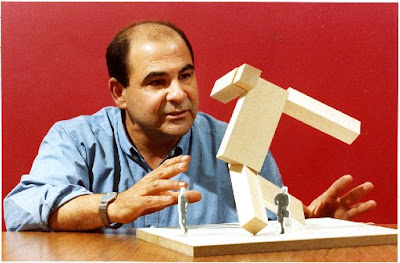
Atonement: Bringing Gumby back

If you read my Thursday op-ed, “Some good ideas, in need of patrons,” you may have noticed the end section, about getting Gumby back.

The whole sordid episode involving New York sculptor Joel Shapiro – whose career in 1987 was just starting a sharp upward trajectory – was embarrassing at the time and helped firmly entrench a national image of Charlotte as a city of rubes and rednecks.

Our city art commission had chosen his proposal for a 22-foot bronze work, a collection of rectangles resembling a human in motion, for the front of the to-be-built (and now demolished) Charlotte Coliseum on Tyvola Road. But one art commission member, Robert Cheek – who later went to prison for cocaine trafficking – didn’t like the choice. He helped whip up popular scorn. Either Cheek or deejays John Boy and Billy dubbed the figure “Gumby,” after the green clay animated figure.

Ultimately the City Council, which in those days had final say on public art purchases, nixed it 7-4. History note: Voting against the work were Richard Vinroot (later to be mayor), Ann Hammond, Al Rousso, Ron Leeper, Roy Matthews, Gloria Fenning and Minette Trosch. Trosch said she feared repercussions on the public art program if they accepted the art. Voting for it were Cyndee Patterson, Pam Patterson, Charlie Dannelly and Velva Woollen.

Of course, the “Angels in America” spat 10 years later didn’t help. Just as people elsewhere were starting to forget how many Charlotte folks were keen to make fun of art, we reminded them that many here were also so homophobic they’d kill funding to the arts because a theater group performed a work that depicted gay men.

Cut to 2011. I see the affection people have for Niki de Saint Phalle’s “Firebird” – dubbed Disco Chicken by some – at the Bechtler. You can hardly go by (and since it’s between my office and Amelie’s coffee shop, I go by it a lot) without seeing someone photographing someone else at the Firebird. The temporary exhibition of large Saint Phalle works in the park across from the museum draws a steady stream of viewers, including children scampering through that huge skull. (Be sure to go inside, where it’s mirrored and blue and serene.) The Bechtler, filled with modern art, is drawing great crowds.

I think Charlotte has matured. Finally.

The whole episode was painful for Shapiro. He later told the Observer’s Richard Maschal it was “a low point” in his career. Shapiro was at that 1987 council meeting. Our old files have a photo from the meeting, with Shapiro looking on as a speaker holds a clumsy wooden contraption saying it was something he made in fifth grade. The photo caption doesn’t say that the speaker was making fun of Shapiro’s work, but that would certainly be my guess.

Seeing which way the vote would go, Shapiro left before it was taken and returned to New York. Today his work is in major museums all over the country, including the National Gallery and the N.C. Museum of Art. You can see it at Davidson College. You can see it in Greenville, S.C. But not in Charlotte.

So why don’t we try to bring that Shapiro work back to where it should have been all along? Although it would have cost $400,000 in 1987, today his works can sell for seven-figure (corrected) sums. This would take patrons with significant money. Queens Table, where are you?

Would Shapiro consent to this? He might not. But maybe he’d see that this city has grown and changed. Sure, there are plenty of people (including some politicians) who think any sculpture other than soldiers on horseback is weird, or who look at a Picasso and say, “My fifth-grader could do that.” But that’s true in New York as well as Charlotte. The difference is that there are plenty of people here today with a much wider appreciation of art.

Plus, I think there’s a reason the name “Gumby” stuck, even among Shapiro supporters who were angry and embarrassed about the whole thing. Even the tiny wooden model had life and spark, and so much personality it demanded a name. So Gumby it became, and Gumby is how it is remembered in local lore.

Now it’s time to bring him home. After all, Disco Chicken needs a buddy.

Photo: 1987 Observer file photo of Joel Shapiro with a model of his proposed sculpture. Photo by Diedra Laird.

Our mayor in Spandex?

Charlotte Mayor Anthony Foxx, at his regular news briefing Thursday, mentioned that he’s been teaching his kids, 6 and 4, to ride bikes and said he went out and bought himself a road bike, the kind with toe clips that he’s still learning how to use.

The last few days, he said, “I’ve gone out at 5:30 in the morning and gone down to the Little Sugar Creek Greenway.” He talked about wanting to make the city friendlier to bicycling.

All of which leaves the obvious question, which yours truly was the only journalist in the room willing to ask: “So, are you wearing Spandex?”

Foxx: “I’m not answering that.”

Which I think means he must be.

So, dear readers, if anyone wants to volunteer to be a citizen journalist and go down on the greenway at – as my friend Brenda would say, “O-dark-thirty” – and try for a mayoral Spandex sighting, please let me know what you discover.

Devlopers, JCSU want city money for catalyst project

Should the city help Johnson C. Smith University and a private developer with a project on West Trade Street? The council will likely be deciding that question in coming weeks.

Monday night JCSU official Malcolm Graham – a former City Council member whose other hat is to be a state senator – and Mike Griffin of Griffin Brothers showed the council plans for Mosaic Village, which would be student housing subsidized by JCSU, with street-level retail and a parking deck. Griffin said the project has a $4 million financing gap. Coincidentally, that’s almost exactly the cost of building the parking deck.

Graham and Griffin didn’t ask the council for any specific help, or lay out a specific request. The matter goes to the council’s Economic Development committee. Mayor Anthony Foxx noted that the city has a corridor revitalization strategy.

West Trade and Beatties Ford Road have languished as other neighborhoods near uptown began to blossom. But things are afoot. The Wesley Heights neighborhood nearby has had growing numbers of urban pioneers moving in. JCSU’s president, Ron Carter, has made a point of trying to better link the school with both its immediate community and the larger Charlotte community. Take a drive up West Trade and you’ll see an area ripe for fresh projects – which would raise the tax base and thus, help city and county finances over time. Would this one be the catalyst the area needs? Or money down a sinkhole? Or somewhere in between?

That’s what the City Council will have to figure out. Despite the usual crowd of naysayers who object to almost all city spending beyond the bare basics, smart city investments can have a big payoff later. Example: When the city bought the unused rail corridor along South Boulevard. Now it’s the Lynx light rail. South End has seen millions of dollars worth of private investment – new building, rehabs, new business. But as always, knowing which investments are “smart” will be tough part.

Road planning from the disco era – the rest of the story

In putting together my op-ed, “Road planning from the disco era,” the limitations of space and time required me to leave out some juicy tidbits. You lucky blog readers now may read the rest of the story.

I wrote that the N.C. Turnpike Authority is required by the feds to analyze impacts/effects of the very roads that the authority is, by law, expected to build. The point here is that the legislature, for example with the 1989 Highway Trust Fund, decides to build roads well in advance of any detailed and painstaking analysis of whether the damage they’ll do will be worse than their benefits. Today, significant questions have been raised about both Gaston County’s Garden Parkway and the Monroe Bypass – the latter having been ordered up by legislature in 1989.

Let’s let politicians, not planners, choose the routes. March 17 the General Assembly passed, and the next day the governor signed, a bill that in essence requires the N.C. Turnpike Authority to consider only one route – the most sprawl-inducing one – for the proposed Triangle Expressway Southeast Extension toll road, a link of Raleigh’s I-540 outer loop. The bill, sponsored by Wake Sens. Dan Blue, D, and Sen. Richard Stevens, R, appears to box the turnpike authority into such a spot that it might not be able to meet federal law. The feds require analysis of several alternatives.

“We think that they’ve probably backed themselves into an untenable corner,” says David Farren of the Southern Environmental Law Center. He adds, “What’s most outrageous is just the idea of going as far out as you possibly can, which means the road is longer, the road is more expensive and it’s more sprawl-inducing.” The SELC has filed two lawsuits contesting what it says are improprieties and falsifications involving the federal impact study for the Monroe Bypass.

Why spend only $15 million when you can spend $800 million? Another tidbit that didn’t make the column: The SELC found a 2007 NCDOT study showing that for $15 million, traffic flows on U.S. 74 in Union County could be improved significantly by changing lights, timing and intersections. The N.C. Turnpike Authority, engaged in studying the $800 million Monroe Bypass which aims to alleviate congestion on U.S. 74, didn’t even know that study existed, Farren says.

The state doesn’t do land use planning. And Richard Nixon wasn’t a crook and Bill Clinton never had sex with that woman. When the state plans highways, it engages in land use planning. Next time the state agrees to spend your tax dollars to build a bypass for a city that hasn’t had the sense to say no to congestion-causing highway sprawl development, the state should not pony up dime one until the local government enacts unambiguous land use and zoning ordinances that will prevent said sprawl, including single-family subdivisions, from the new bypass.

The chances of that happening? About like snowballs in hell.

Find the bad bridges in N.C., S.C.

If you get a shiver whenever you drive over the Yadkin River bridge on I-85 between Rowan and Davidson counties, you might find it instructive to spend a few minutes seeing how your county, and your state, compare nationally in a ranking of deficient highway bridges.

The nonprofit Transportation for America coalition has pulled together an online tool that lets you see state and county stats on highway bridges deemed deficient by the federal government. Here’s the North Carolina page. The Tar Heel state ranks No. 14 in the percentage of deficient bridges, 13 percent.

Rockingham County, north of Greensboro, is the worst county, with 33.6 percent of its bridges rated deficient. In the Charlotte metro region, Cabarrus is worst – No. 4 in the state – with 25 percent.

South Carolina is right there with us, ranking No. 15, also with 13 percent of its bridges deficient. The three worst states, in order: Pennsylvania (26.5 percent), Oklahoma (22 percent), Iowa (21.7 percent).

It’s hard to see how this isn’t yet another problem confronting our national and state transportation policies, where (my opinion here) disproportionate money has been spent on building new highways with little regard for the costs of future maintenance.

The group’s assessment of the roots of the problem: “Two key problems persist: while Congress has repeatedly declared bridge safety a national priority, existing federal programs don’t ensure that aging bridges actually get fixed; and the current level of investment is nowhere near what is needed to keep up with our rapidly growing backlog of aging bridges. Did you know that states can transfer up to half of their federal money dedicated to bridge repair to other projects, no questions asked?”

Here’s a link to the page describing what data was used.

And for the record, the NCDOT is working on rebuilding that Yadkin River bridge.

Photo credit: Yadkin River bridge, in 2007 Observer file photo

Highway tales from the crypt

It was like a quick, surprise trip to the mindset of the 1980s. Or maybe like one of those horror movies when something you thought was dead turns out to be twitching in the grave, still alive.

I dropped in on a group of regional elected officials and other civic-leader types who’d gathered Monday afternoon to talk about “next steps” for the worthy-but-unsexy goal of regional transportation planning, with the Centralina Council of Governments moderating a series of conversations by a study group.

It’s one of those under-the-radar issues, boring but important if you think a metro region should act like, well, a metro region and not a bunch of unrelated local governments, especially when it’s dealing with something as important – and as costly to the taxpayers – as transportation. As I’ve mentioned previously (some might even say ad nauseam), the Charlotte metro region has possibly the most fragmented transportation planning of any metro area in the country. Gaston County isn’t in the same transportation planning group as Charlotte. Cabarrus County isn’t either. Ditto York County, S.C., and ditto the whole Lake Norman area.

It was as the group was talking about the need to articulate a vision for the whole region, that the zombie idea arose from the crypt. Gaston County commissioner Joe Carpenter started talking about how it felt like, as Yogi Berra used to say, “deja vu all over again.” He recalled the era from 1988 to 1992, when a regional coalition, the Carolinas Transportation Compact, pushed for – if you said mass transit, or farmland preservation you lose – for an outer-outerbelt highway around Charlotte.

Carpenter then unfurled a large map of the route of this mythical highway, long lusted after by suburban land developers.

Because why have only one outerbelt if you can have two? Haven’t we all seen how well Charlotte’s first outerbelt has relieved congestion, led to smoothly flowing traffic, trimmed the region’s carbon footprint, helped create walkable neighborhoods and made transit easier to implement? Imagine the wonders if we could spread our Pineville- and Ballantyne-style development all over the region’s farmland?

Then-state Sen. Jerry Blackmon had conceived of the idea of a 13-county outer-outerbelt, 30 to 50 miles from Charlotte, in the mid-1980s. Planning continued throughout the 1980s, out of the public eye although land speculators such as Robert Pittenger, later a state senator, bought land along its route. In 1993 its cost was estimated at $2 billion.

Although the Carolinas Transportation Compact backed it, there was a Carolinas Urban Coalition of nearby cities which opposed it, foreseeing that the sprawl it would engender would empty their struggling downtowns. “I find the idea inconceivable,” said then-Charlotte City Council member Lynn Wheeler. “You could take gasoline and pour it on the city of Charlotte and the other cities and light a match. It would have the same effect.”

The newly elected Gov. Jim Hunt was not a fan. “The outer-outerloop strikes me as just being a little farfetched,” he said in early 1993. “I’d be very concerned about spending money on that.” And after that, Observer articles on the outer-outerbelt dwindled. And in the intervening two decades thinking about urban transportation has changed dramatically. Highways have been shown not to relieve congestion, as hoped, but to create it. Willy-nilly suburban growth has been shown to be, in many cases, a net loss for local government revenues rather than the hoped-for boost.

As Carpenter (who’s also a big backer of the dubious Garden Parkway through rural southern Gaston County) spoke, I noticed that the meeting’s chair, Dennis Rash – a former N.C. transportation board member and a one-time key lieutenant to ex-Bank of America CEO Hugh McColl Jr. – wasn’t saying much. I asked him later about the outer-outerbelt idea. Is that what we are to see from a group looking for regional transportation planning? He noted, drily, that the old outer-outerbelt idea had been conceived during a time when the federal government was paying for 90 percent of the cost of highway projects. Those days are gone, probably for good.

And that should be the fate, as well, of yet another outerbelt highway through the Piedmont around Charlotte. Please, no more rising from the crypt for this one.

City pulls plug on proposed loud music measure

City Attorney Mac McCarley tells me the city staff is pulling the plug on a chunk of its proposal to change the city’s noise ordinance. A new version will be offered Monday at the 3 p.m. public hearing that, McCarley says, aims for a balance that won’t hurt performers and bars that aren’t causing problems for neighbors.

The ordinance change has made a lot of musicians, bar owners and nightlife denizens angry, and McCarley said, they’ve been heard. (Read some of the Observer’s coverage here — Mark Washburn – “New noise rule is music to our ears” ; “Pub owners decry new noise limits” ; “Debate over outdoor music in Charlotte”)

The proposed change to the ordinance would have barred “sound amplification equipment out of doors or directed out of doors” for live music or “other forms of entertainment” at a business if the amplifiers are less than 400 feet from residences. It would also bar amplified sound outdoors (note the outdoors, please. It doesn’t apply to indoor music) at a business that’s audible on residentially zoned property.

When I talked to McCarley about noon Friday, he said he and his staff were still working through exactly what they’d propose to the City Council but that it would be aimed at businesses that cause problems and try to protect those that don’t.

How (not) to be a creative city

I was recently walking down the sidewalk beside the Lynx light rail, and I spotted some colorful banners alongside the tracks. They added a festive touch, I thought. Then I read them.

They said: “Create” and “Splurge” and “Thrive” and my favorite, “Groove.” I found this interesting. It had the flowery fragrance of promotional marketing. I checked. Yep, the banners are part of a rebranding effort for South End.

Now I am not against promotional marketing. In an advertising-based industry, how could I be?

But somehow, being ordered to “Thrive” reminded me of a time, years ago, when the walls of the Observer building sprouted posters ordering us all to “Work Smarter.” As if we would all slap our heads in recognition of our heretofore obvious stupidity and decide to mend our ways.

The promotional effort, courtesy of Charlotte Center City Partners, the nonprofit uptown advocacy group that also serves South End, partnered with a South End design/branding firm. They want to highlight “the brand attributes of the district” which they believe to be shopping (hence, “splurge”), residential (“thrive”), art galleries and creative businesses (“create”), and hospitality and nightlife (“groove”).

I called three creative types from around town, plus my college-aged daughter and asked if anyone ever says “groove” any more. “I don’t think so,” said commercial film producer Peggie Porter. “I hear people say ‘groovy’ in a sort of ironic way.”

“No one I know says groove,” said the text my daughter sent from Chapel Hill.

Filmmaker Dorne Pentes, though, said he still sometimes hears people say “groove.”

What about the rest of the banners and being ordered to “create”?

“I think that would be the least likely thing to make me feel creative,” Porter said. “It sounds like Chamber of Commerce stuff to me,” Pentes said.

As one branding/marketing expert told me (no name because this person needs business and can’t afford to tick people off), “In the brand world, what things ARE is most important, not what you say they are. That’s what we focus on with clients. Get them away from slogans.”

Colorful banners? Nice touch. Sloganeering in a supposedly “artsy” part of the city? Not so creative.

A note about spacing: For some reason blogger.com today refuses to put spaces between the paragraphs. I tried deleting the old spaces, putting in new “enter” lines, the works. No luck. Does anyone have any solutions for this?

Why DO conservatives hate trains?

Found while looking up something else: An interesting piece in Slate.com, “Why do conservatives hate trains so much?”

Writer David Weigel dissects the opposition and notes it’s more libertarian than conservative (other than a delusional George Will line about trains – “…the real reason for progressives’ passion for trains is their goal of diminishing Americans’ individualism in order to make them more amenable to collectivism.” Whoa, George, you might wanna dial back the paranoia a tad.)

Libertarians, Weigel notes, don’t have a problem with transportation. What they and some Republicans have a problem with is federal spending on transportation. But then, the article goes on to note, “Amtrak passengers pay more of the cost of their transportation than do drivers on the interstate. About 62 percent of Amtrak’s operating expenses, according to the Department of Transportation, comes from fares. According to the Federal Highway Administration, the percentage of highway spending paid for by users—in the form of gas taxes and tolls—is headed below 50 percent.”

Weigel goes on to quote other reasons some conservatives don’t like rail transit, although little of what he reports as their reasons square with the reality that highways are just as expensive, just as prone to go over budget, just as heavily subsidized.

Ultimately, in my opinion (and Weigel gets at some of this) conservatives don’t like rail because liberals do. Some people will do anything in order not to be in the same camp with people whose beliefs they disdain. This is not limited to politics, of course, and seems to be a general part of human nature. Have you ever been around UNC and Duke basketball fans? They make liberal-conservative spats look tame.