Old depot may yet escape bulldozer

Photo courtesy Charlotte-Mecklenburg Historic Landmarks Commission

The historic passenger depot off Freedom Drive, the Thrift P&N station, may yet be saved from demolition. A complicated property deal is in the works, involving the depot’s owner, CSX railway, as well as the Charlotte-Mecklenburg Historic Landmarks Commission and the N.C. Department of Transportation.

As I first wrote in November (City may seek landmark demolition) the station dates to the Piedmont and Northern electric suburban rail system developed by power company and tobacco magnate James B. Duke and power company executive William States Lee (who ran the forerunner of Duke Energy). The railway opened in 1912; passenger service ended in 1951. The station, designed by prominent Charlotte architect C.C. Hook (he designed the Duke Mansion and old City Hall), is the last P&N passenger station in Mecklenburg County.

It’s a designated landmark, but in North Carolina designated landmarks can be demolished if the owner desires. The old depot was caught up in the city’s new, well-intentioned nonresidential building code, adopted last April and aimed at cleaning up dilapidated, blighted buildings. CSX hadn’t kept the old depot in good repair, and after an inspection the city ordered repairs or demolition. CSX applied for a permit to demolish. The city-county landmarks commission has power to delay demolitions for a year and did so.

Walter Abernethy, the city’s code enforcement manager, told the City Council on Monday that an agreement had been reached to save the depot. He might have been a wee bit prematurely optimistic. Dan Morrill, the consulting director for the landmarks commission, says that CSX has
has agreed to withdraw its demolition application for a year to let NCDOT and the landmarks commission try to put together this scenario:

• NCDOT acquires property nearby, across track. If it succeeds, NCDOT allows the depot to be moved onto that new site.
• CSX would then donate the station to the HLC. The HLC would move the station to the new site and restore it for an interim adaptive reuse. CSX might donate some money for the move and restoration, Morrill said.
• If and when NCDOT acquires the former P&N track for passenger use (it owns about 15 miles of the railway, some near uptown Charlotte but mostly in Gaston County where re-opening freight operations) then NCDOT would buy the station from the HLC for use as a passenger. But currently NCDOT has no plans for passenger rail along the line.

Obviously, the plan hinges on NCDOT acquiring land. But if all the pieces fall into place – still a big if – in a weird sort of irony the demolition threat may well end up having saved the old depot from what was starting to look like “demolition by neglect.”

Old depot may yet escape bulldozer

Photo courtesy Charlotte-Mecklenburg Historic Landmarks Commission

The historic passenger depot off Freedom Drive, the Thrift P&N station, may yet be saved from demolition. A complicated property deal is in the works, involving the depot’s owner, CSX railway, as well as the Charlotte-Mecklenburg Historic Landmarks Commission and the N.C. Department of Transportation.

As I first wrote in November (City may seek landmark demolition) the station dates to the Piedmont and Northern electric suburban rail system developed by power company and tobacco magnate James B. Duke and power company executive William States Lee (who ran the forerunner of Duke Energy). The railway opened in 1912; passenger service ended in 1951. The station, designed by prominent Charlotte architect C.C. Hook (he designed the Duke Mansion and old City Hall), is the last P&N passenger station in Mecklenburg County.

It’s a designated landmark, but in North Carolina designated landmarks can be demolished if the owner desires. The old depot was caught up in the city’s new, well-intentioned nonresidential building code, adopted last April and aimed at cleaning up dilapidated, blighted buildings. CSX hadn’t kept the old depot in good repair, and after an inspection the city ordered repairs or demolition. CSX applied for a permit to demolish. The city-county landmarks commission has power to delay demolitions for a year and did so.

Walter Abernethy, the city’s code enforcement manager, told the City Council on Monday that an agreement had been reached to save the depot. He might have been a wee bit prematurely optimistic. Dan Morrill, the consulting director for the landmarks commission, says that CSX has
has agreed to withdraw its demolition application for a year to let NCDOT and the landmarks commission try to put together this scenario:

• NCDOT acquires property nearby, across track. If it succeeds, NCDOT allows the depot to be moved onto that new site.
• CSX would then donate the station to the HLC. The HLC would move the station to the new site and restore it for an interim adaptive reuse. CSX might donate some money for the move and restoration, Morrill said.
• If and when NCDOT acquires the former P&N track for passenger use (it owns about 15 miles of the railway, some near uptown Charlotte but mostly in Gaston County where re-opening freight operations) then NCDOT would buy the station from the HLC for use as a passenger. But currently NCDOT has no plans for passenger rail along the line.

Obviously, the plan hinges on NCDOT acquiring land. But if all the pieces fall into place – still a big if – in a weird sort of irony the demolition threat may well end up having saved the old depot from what was starting to look like “demolition by neglect.”

NCDOT chief: No more bypasses of bypasses

Don’t expect the state to build your city a bypass to compensate for the existing bypass your local governments have glopped up, State Transportation Secretary Gene Conti said today. “Those days are gone,” he said.

OK, he didn’t say “glopped up.” That’s my description. Conti dropped by the Observer editorial board today in between local meetings in town – a business roundtable at UNC Charlotte, and he’ll be at the 5 p.m. Charlotte City Council meeting for a discussion about recommendations for the Independence Boulevard project (also see this link, for more information).

He was being questioned about two toll road projects, the so-called Garden Parkway in Gaston County (See “Money-waster road will induce sprawl”), and the proposed Monroe Bypass. Both highways are needed, he said. That’s his story and he’s sticking to it, obviously. After all, the legislature has ordered them both, and Conti’s job is to produce the roads he’s charged with.

Neither of those highways, of course, is worth the taxpayer money that will be spent. But the Monroe bypass is at least an attempt, however uncreative, to ease a terribly unpleasant drive along U.S. 74 through Monroe and Union County.

The problem, of course, is that you can hardly go anywhere in North Carolina, or even in the country, and not find a state-taxpayer-built highway envisioned as a “bypass” that has become a traffic nightmare because the local government involved allowed extreme highway glop to be built along it. Even places as comparatively traffic free as Albemarle have clogged bypasses. Shelby wants a bypass of its bypass. They are all what former Charlotte Mayor Pat McCrory has referred to as “corridors of crap.”

So, I asked Conti, should the state’s taxpayers reward those towns with another new bypass?

His reply: “Well, no.”

“All of us would benefit from a much greater collaboration on those growth issues,” he said. He said the DOT is trying to work to bring local governments more into transportation discussions.
“The days of just trying to continually build bypasses of bypasses, those days are gone,” he said.

So Shelby, Albemarle, Asheboro, Ramseur and all the other N.C. towns that have allowed corridors of crap along your state highways, be forewarned.

The realist in me, though, requires me to mention this: If the legislature orders a highway to be built, as it did via the Highway Trust Fund of the late 1980s, there’s not much a DOT secretary can do about it.

Historic church gets saved on Seigle Ave.

It looks as if the Seigle Avenue Presbyterian Church sanctuary won’t be demolished. Neighbors, church members and other interested parties found a local builder-developer who has contracted to buy the old church property. Monday night the Charlotte City Council granted a 90-day delay in the city’s demolition order.

As I wrote in my Jan. 28 op-ed, “Once-loved sanctuary faces the end,” the church may not be an architectural gem, but it and its congregation played a notable role in ongoing efforts here to create more racially integrated congregations. It was, I wrote, “a small congregation, racially integrated for more than 40 years. For decades that 1950 sanctuary was home to a group of African-American and white Christians puzzling their way through barriers of race, income, gender, class and other inequities – a journey so difficult that many other people and groups in Charlotte have not really begun it.”

The congregation split over a variety of issues, with many long-time former members of both races joining Caldwell Memorial Presbyterian Church. The remaining Seigle members moved up the street to another building five years ago and put the old property on the market. But the real estate slowdown, the three buildings’ bad condition and the lack of parking made it a difficult sale. The city’s new building code for non-residential property, when applied to the church property, resulted in a demolition order. In January the City Council granted a 30-day demolition delay, after the church’s real estate agent said he thought he had found a buyer.

Monday night, the buyer himself – Brandon Brown of Green City Development – told the City Council he would close on the property in about a week and asked for 150 days’ delay in the demolition order so he could tear down the oldest building and start repairing the sanctuary and fellowship hall. He’s also asking to buy 2 city-owned acres behind the church to use for more parking; those negotiations will be more complex and his purchase of the church isn’t contingent upon that separate land purchase.

Brown said he’d like to turn the church sanctuary into a restaurant (he didn’t use the example of Bonterra in Dilworth, but I will) and the fellowship hall into a coffee shop or office. The City Council gave him a 90-day extension of the demolition. Brown was good with that.

The city’s nonresidential building code is well-intentioned but it’s having the effect of threatening historic landmark buildings, as I wrote in November’s “City May Seek Landmark Demolition.” (The Seigle Avenue church building wasn’t a landmark.)

Observer file photo below showing the front of the sanctuary was taken in 1993.

‘City-Suburban Smackdown’ and other news

Cities v. Suburbs: The Carbon Smackdown: The infrastructurist.com in “New Study: Suburbs Can Pollute More Than Cities” reports on a new study that may set some conventional wisdom on its ear: “When blame is assigned for greenhouse gas emissions, big cities typically receive more of it than smaller cities and suburbs. But a new report in a recent issue from of Environment & Urbanization suggests casting a more nuanced net of responsibility. In fact, contrary to popular wisdom, cities can have a per capita rate of greenhouse gas emissions that’s astonishingly lower than rates in their surrounding suburbs.”

Schoolyard Fight – Green V. Urban: This article from the Boston Globe, “Green Building,” is making the rounds among landscape architects, urban designers and related folks. New Urbanist leader Andres Duany (a graduate of Princeton and Yale) is picking a fight with Harvard’s Graduate School of Design. When Duany was in Charlotte earlier this month he told me one reason he was kicking up dust was to energize young New Urbanists. It’s a movement, he said, that needs people with the energy to enjoy Sisyphean tasks.

Ex-mill town nurtures its downtown. Kannapolis, a one-time mill town built and dominated for decades by the Cannon family and Cannon Mills, was for years the largest unincorporated town in North Carolina. It finally incorporated in 1984. It’s an interesting place, especially if you’re keen on N.C. history, because many of the mill houses, built for the textile workers, still exist. So does the Williamsburg-style brick downtown.

Cannon Mills became Pillowtex, which abruptly closed in 2003, sending thousands out of work. The former Cannon Mills Plant No. 1 was demolished to make way for the still unfinished N.C. Research Campus. (I’m leaving out a lot. For more, see the N.C. Research Campus site here.)

Kannapolis is working on a new downtown plan. Here’s a link to a draft of the plan. And here’s an article from the Independent Tribune.com, by former Observerite Karen Cimino Wilson. A big problem: Since the huge mill closed the downtown stores have suffered. Among the proposals: Transforming Dale Earnhardt Boulevard/Loop Road from a suburban highway to an “urban boulevard.” Building a City Market building. Creating better gateways to the downtown area.

K-12 Transportation Costs: Charles Marohn, New Urban Network writes about what he sees as school transportation policies that subsidize inefficient development patterns. In the New Urban Network, he writes: “Door-to-door transportation for K-12 students may seem to be a compassionate policy from a society that values both students and education. That may be the intent, but the transportation mandate ultimately takes money from classrooms to subsidize our inefficient, post-WW II development pattern. In the end, it also devalues traditional, neighborhood schools in favor of the remote, campus-style we now build.”

Be forewarned. Marohn makes explicit that he’s not considering the considerable issues of race and school integration: “Again, I’m not trying to get into a broader discussion on race. I’m not thinking that big,” he cautions.

With Gov. Bev Perdue proposing making counties, not the state, responsible for buying school buses – one gigantic unfunded mandate – and Charlotte-Mecklenburg Schools for all practical purposes resegregated anyway (I’m not supporting that, but acknowledging reality) it’s past time for CMS and the city and county local governments to work together to make it easier for kids who do live within a mile of schools to be able to walk there safely. And for CATS and CMS to figure out better ways to collaborate. And for parents to stop being afraid that putting a 10-year-old on a city bus is a huge risk, when in fact the much bigger risk is putting a kid into a private auto. Remember, car wrecks are the leading cause of death for Americans ages 1-35.

Knoxville + Charlotte = Same league?

While folks in Charlotte are still elated over being selected for the 2012 Democratic National Convention, The Economist magazine has deftly slid a stiletto under the city’s civic ribcage:

In its Feb. 10 issue, “Changing leagues: What landing the convention says about North Carolina’s biggest city,” the writer quotes Charlotte Center City Partners’ Michael Smith: ““We’re changing leagues.”

The magazine goes on to describe the city: “It has a couple of professional sports teams, the NASCAR Hall of Fame, a sleek new light-rail system and a decent but hardly remarkable smattering of museums and theatres. It seems just one of several pleasant, medium-sized cities—such as Knoxville, Richmond and Norfolk—between Washington, DC, and Atlanta.”

Keeping in mind that Charlotte’s estimated 2006 population, according to the U.S. Census Bureau was 630,478, it’s instructive to note that the Census Bureau also reports:

• Richmond’s 2010 population at 204,000 and Norfolk’s at 242,803.
• Knoxville? Its 2006 population estimate was 182,337.

All those years of spending, building, scrapping and clawing and climbing by the fingernails into the NBA and the NFL, building towering phallic bank and energy company skyscrapers to prove the city’s virility, were they for nothing? Can it be possible that to the rest of the world, which now appears not to have been paying the least bit of attention, Charlotte is still considered a “pleasant medium-sized city,” maybe about like Knoxville?

Ouch! Ooof! Uggghh! And grrrrr!!! You can hear the teeth grinding up and down Tryon Street.

Urban acupuncture and the American Dream

We now live in the Century of the City, so called because last year the global human population counter rolled over the 50 percent mark – More than half the world’s people now live in urban areas.

But in the U.S., the 21st century will also have to be the Century of the Suburb – the re-imagined suburb. That’s particularly true in Sun Belt cities such as Charlotte, Raleigh, Atlanta, Orlando, etc., where such a large proportion of land is given over to postwar suburban development. In coming years we’ll have to decide how to, as Georgia Tech architect and author Ellen Dunham-Jones puts it, re-inhabit, retrofit and re-green those areas.

The imperatives are economic, environmental and demographic.

1. Carbon and greenhouse gases. If we’re to avoid creating even more damaging and destructive changes in the world’s climate (increasing droughts, floods, snow or burning heat, depending on where you are) for our kids and grandkids to deal with, then an excellent way to shrink U.S. production of greenhouse gases is to reduce how much people drive.

Even for people who insist on believing that all the world’s climate scientists (who compete with one another and back-bite as avidly as any other professionals) have joined to perpetuate a worldwide hoax, there are other excellent reasons to reduce the U.S. driving habits: the cost to households and businesses of higher fuel prices, not to mention driving itself, with transportation taking an average 19 percent of U.S. household income; depending on other countries for our fuel; air pollution; the vast cost of building and maintaining roads and streets to accommodate ever-more driving.

2. Demographics. Population realities are converging to favor urban/multifamily/higher density development. Gen Y (aka the Millennials) have a clear preference, at least at this stage in their lives, for urban environments. Meantime, many aging boomers will be selling their houses and moving into condos or apartments. Many of them will also have to give up driving due to infirmity, illness or eyesight, so they’ll be looking for neighborhoods where they can walk to stores and medical offices.

3. The emerging obesity epidemic. Driving more means exercising less. Human beings haven’t suddenly lost their ability to have will power. We have structural issues that are making us fat. One of them is that we don’t walk much anymore, because we have to drive.

4. Suburbs on the brink. Many of the postwar suburban neighborhoods (and by “suburban” I mean low-density, auto-oriented neighborhoods or towns carved up into single-use zones) are fading. To be sure, many thrive and will continue to, even as the market for single-family houses stagnates through oversupply (see item 2, above). But already, many cities including Charlotte are puzzling over fixes for dead or dying enclosed malls, derelict strip centers and big box stores, and neighborhoods with dwindling property values and rising crime and social problems.

I was privileged to spend Saturday moderating a conference in Raleigh, sponsored by the N.C. State College of Design, looking at the problem of, and opportunities for, inner-ring suburbs – which generally means those built in the late 1940s through the 1960s.

The clear consensus was that cities and metro areas will have to learn how to encourage more development closer to their core, and to build more transit lines. Some tidbits from some of the speakers:

• William Hudnut, former mayor of Indianapolis (he joked about “India-No-Place”) gave a definition of “sustainable” that I liked: “Stuff that endures.” He said the first-tier suburbs are “the place where blight can either be stopped or spread farther out.” He used a term I love: “urban acupuncture,” which he attributed to Brazil’s Jaime Lerner, a former mayor (Curitiba) and state (Parana) governor. The idea is to be strategic with well-placed interventions that help heal the surrounding area.

“Progress is not always new,” he reminded the crowd. Other advice: Eradicate ugliness, and “multiply picnics.” Finally, he offered a pertinent quote from Ernest Hemingway that I intend to repeat often: “making strong the broken places.”

• Patrick Condon of the University of British Columbia, author of “Seven Rules for Sustainable Communities,” showed how, when looked at based on 30-year amortization, streetcars are a cheaper form of mass transit than buses. “The cost of buying buses, this year, is cheaper,” he said. But long-term, building and operating streetcars is cheaper for transit systems. He showed slides of old streetcar rails popping out of the pavement (no, he didn’t have a photo of the one on North Tryon Street) “wanting so much to be used.”

• Ellen Dunham-Jones of Georgia Tech, co-author of “Retrofitting Suburbia,” noted that “nobody is plowing down existing neighborhoods” but instead there are opportunities to build infill, especially on what she called “underperforming asphalt.” It requires creativity and innovative ways of developing, she said.

Wrap-up speaker Patrick Phillips, CEO of the nonprofit Urban Land Institute, made the point that close-in neighborhoods can have a great appeal due to their proximity to employment centers and to transit options – unlike far-flung “exurbs,” he said, many of which are seeing high rates of foreclosures in the recession. And he used some research from the Center for Neighborhood Technology, looking at Raleigh-Durham-Chapel Hill, that showed that when transportation costs are figured in, exurban areas that look most “affordable” are, in fact, the least affordable. (See “Penny Wise, Pound Fuelish.”)

The wrapup? Marvin Malecha, dean of the NCSU College of Design, took aim at today’s use of “the American Dream” to mean a house in the suburbs. Come on, he said, isn’t there in fact a different dream that we all have? “The real American Dream,” he said, “is that our children will be OK.”

Urban acupuncture and the American Dream

We now live in the Century of the City, so called because last year the global human population counter rolled over the 50 percent mark – More than half the world’s people now live in urban areas.

But in the U.S., the 21st century will also have to be the Century of the Suburb – the re-imagined suburb. That’s particularly true in Sun Belt cities such as Charlotte, Raleigh, Atlanta, Orlando, etc., where such a large proportion of land is given over to postwar suburban development. In coming years we’ll have to decide how to, as Georgia Tech architect and author Ellen Dunham-Jones puts it, re-inhabit, retrofit and re-green those areas.

The imperatives are economic, environmental and demographic.

1. Carbon and greenhouse gases. If we’re to avoid creating even more damaging and destructive changes in the world’s climate (increasing droughts, floods, snow or burning heat, depending on where you are) for our kids and grandkids to deal with, then an excellent way to shrink U.S. production of greenhouse gases is to reduce how much people drive.

Even for people who insist on believing that all the world’s climate scientists (who compete with one another and back-bite as avidly as any other professionals) have joined to perpetuate a worldwide hoax, there are other excellent reasons to reduce the U.S. driving habits: the cost to households and businesses of higher fuel prices, not to mention driving itself, with transportation taking an average 19 percent of U.S. household income; depending on other countries for our fuel; air pollution; the vast cost of building and maintaining roads and streets to accommodate ever-more driving.

2. Demographics. Population realities are converging to favor urban/multifamily/higher density development. Gen Y (aka the Millennials) have a clear preference, at least at this stage in their lives, for urban environments. Meantime, many aging boomers will be selling their houses and moving into condos or apartments. Many of them will also have to give up driving due to infirmity, illness or eyesight, so they’ll be looking for neighborhoods where they can walk to stores and medical offices.

3. The emerging obesity epidemic. Driving more means exercising less. Human beings haven’t suddenly lost their ability to have will power. We have structural issues that are making us fat. One of them is that we don’t walk much anymore, because we have to drive.

4. Suburbs on the brink. Many of the postwar suburban neighborhoods (and by “suburban” I mean low-density, auto-oriented neighborhoods or towns carved up into single-use zones) are fading. To be sure, many thrive and will continue to, even as the market for single-family houses stagnates through oversupply (see item 2, above). But already, many cities including Charlotte are puzzling over fixes for dead or dying enclosed malls, derelict strip centers and big box stores, and neighborhoods with dwindling property values and rising crime and social problems.

I was privileged to spend Saturday moderating a conference in Raleigh, sponsored by the N.C. State College of Design, looking at the problem of, and opportunities for, inner-ring suburbs – which generally means those built in the late 1940s through the 1960s.

The clear consensus was that cities and metro areas will have to learn how to encourage more development closer to their core, and to build more transit lines. Some tidbits from some of the speakers:

• William Hudnut, former mayor of Indianapolis (he joked about “India-No-Place”) gave a definition of “sustainable” that I liked: “Stuff that endures.” He said the first-tier suburbs are “the place where blight can either be stopped or spread farther out.” He used a term I love: “urban acupuncture,” which he attributed to Brazil’s Jaime Lerner, a former mayor (Curitiba) and state (Parana) governor. The idea is to be strategic with well-placed interventions that help heal the surrounding area.

“Progress is not always new,” he reminded the crowd. Other advice: Eradicate ugliness, and “multiply picnics.” Finally, he offered a pertinent quote from Ernest Hemingway that I intend to repeat often: “making strong the broken places.”

• Patrick Condon of the University of British Columbia, author of “Seven Rules for Sustainable Communities,” showed how, when looked at based on 30-year amortization, streetcars are a cheaper form of mass transit than buses. “The cost of buying buses, this year, is cheaper,” he said. But long-term, building and operating streetcars is cheaper for transit systems. He showed slides of old streetcar rails popping out of the pavement (no, he didn’t have a photo of the one on North Tryon Street) “wanting so much to be used.”

• Ellen Dunham-Jones of Georgia Tech, co-author of “Retrofitting Suburbia,” noted that “nobody is plowing down existing neighborhoods” but instead there are opportunities to build infill, especially on what she called “underperforming asphalt.” It requires creativity and innovative ways of developing, she said.

Wrap-up speaker Patrick Phillips, CEO of the nonprofit Urban Land Institute, made the point that close-in neighborhoods can have a great appeal due to their proximity to employment centers and to transit options – unlike far-flung “exurbs,” he said, many of which are seeing high rates of foreclosures in the recession. And he used some research from the Center for Neighborhood Technology, looking at Raleigh-Durham-Chapel Hill, that showed that when transportation costs are figured in, exurban areas that look most “affordable” are, in fact, the least affordable. (See “Penny Wise, Pound Fuelish.”)

The wrapup? Marvin Malecha, dean of the NCSU College of Design, took aim at today’s use of “the American Dream” to mean a house in the suburbs. Come on, he said, isn’t there in fact a different dream that we all have? “The real American Dream,” he said, “is that our children will be OK.”

“Prudent Growth”? Multifamily McMansions?

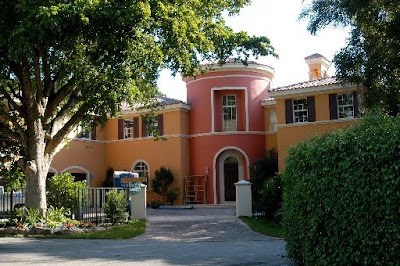
A Coconut Grove, Fla., McMansion circa 2003. Are McMansions destined to be apartment houses in the next decade? (Miami Herald photo)
I came away from last week’s New Partners for Smart Growth conference with a notebook full of interesting ideas, factoids and thoughts:

• Can we scrap the term Smart Growth? It insults people, which doesn’t help anyone make needed political and business changes. But “sustainability” isn’t much better. For one thing, the way a community develops is much more complex than buying fluorescent light bulbs, which is what “sustainability” means to a lot of people. “I try to avoid using the word ‘sustainability,’ ” Raleigh Planning Director Mitch Silver, who is president-elect of the American Planning Association, told the crowd Saturday. The term means too many things to too many people, he said.
I vote for not calling it anything, since any good planner/urban designer/policy maker worth her or his salt knows what to do anyway. If a term is absolutely required, what about “Prudent Growth” or “Responsible Growth”?

• Two different planning/development experts predicted that many of the McMansions built in the past decade will end up being broken into multifamily housing. Arthur “Chris” Nelson, who gave an interesting demographics presentation, even offered floor plans for converting a 6,000-square-foot-house – “modest by McMansion standards” – into three apartments. He noted that multifamily’s share of the demand for new housing 2010-20 will be 50 percent. Considering population, age and market-demand projections, the U.S. is overbuilt on single-family housing, he said, and underbuilt on multifamily.
Silver, of Raleigh, also pointed to that likely result. “What are we going to do with those 4,000-square-foot mansions out in the suburbs,” he asked.
• Silver gave an excellent talk about Raleigh’s planning and zoning efforts. He self-deprecatingly noted the city’s “Sprawleigh” nickname and described a wide-ranging effort Planning Raleigh 2030, that aimed to get residents to envision what they wanted their city to look like in two decades. (They used different outreach methods for different age groups.) The city’s new comprehensive plan was adopted in 2009. Unlike Charlotte, that isn’t all the city did. “If you just have a policy plan sitting on a shelf, it has no value,” Silver said. “It’s important to have the one-two punch” of adopting the plan and then codifying it.
So the city is completely rewriting its zoning code, which will be, in part, a form-based code. That’s a code that worries less about what you’re doing inside the building (office? store? apartments?) and more about how the building behaves in its surroundings. “Sprawl is fiscally irresponsible and frankly, too expensive to maintain,” he said. (I guess he doesn’t have to worry about REBIC and influential suburban subdivision developers complaining to his bosses when he says things like that, right out loud and in public.)

• The Atlanta BeltLine project was described as “the most transformative project in Atlanta since the airport was built.” (quote is from Atlanta City Council member Joyce Sheperd). It’s a $2.8 billion redevelopment project to create public parks, multi-use trails and transit along a mostly abandoned 22-mile railroad corridor that encircles downtown Atlanta and connects 45 neighborhoods. It’s a huge partnership, and involves a 6.500-acre tax increment financing district (covering 8 percent of the city’s land area). Along with local, state and federal money expected to be spent, a nonprofit Atlanta BeltLine Partnership is raising money from philanthropic and private sources, as well as local, state and federal funds.

Almost half the right-of-way has been leased, optioned or purchased. So far 3.5 miles of permanent trails have been built, as well as 8 miles of interim hiking trails.
Brian Leary, CEO of Atlanta BeltLine Inc., told the conference gathering, “For the last 14 years Atlanta has been looking for its next Olympic moment.” He clearly thinks the BeltLine is it.

From ‘Smart Growth’ to ‘intelligent cities’

A Cary, N.C., subdivision circa 1997 (News & Observer file photo)

This is my Saturday op-ed column. I’m posting it early for all you Naked City readers.

It’s been a while since I heard people talking about Smart Growth.

Some of that’s because Charlotte’s seen little growth, smart or otherwise, since late 2008. Consider the change: In 2008 the City of Charlotte approved 35 single-family subdivisions, totaling 1,407 lots on 612 acres. In 2009 it approved four, in 2010 just two.

Even before 2008, though, it seemed the term Smart Growth had been supplanted. I’ve heard “resilient cities,” “sustainable communities,” or – today’s fad – “intelligent cities.” Urban sociologist Robert Lang told USA Today recently that, as a term, “smart growth is at the end of its shelf life.”

Despite terminology, the topic still pulls in a crowd. Some 1,200 people came to Charlotte this week for the New Partners for Smart Growth national conference. Sessions showcased topics from traffic safety to food systems to so-called “zombie” subdivisions – platted but unbuilt – (here’s a link to a report on zombie subs from Anthony Flint of the Lincoln Institute of Land Policy, which helped organize the session).

The breadth of topics helps show how widely Smart Growth has been embraced, yet hints, too, at one reason the term faded. What began as a welcome alliance among environmentalists, New Urbanists and transit advocates kept inviting others into its tent, adding worthy goals such as economic inequities and social justice. In time its cohesive message blurred.

Meantime, themes that 25 years ago were outsiders to conventional planning became embedded in the profession. You don’t find many planners now who don’t know that the circa-1955, large lot, single-family residential codes aren’t environmentally or fiscally prudent. Even traffic engineers are coming around to embrace bike lanes and sidewalks.

When I first wrote about Smart Growth a dozen years ago, I’d have to explain it. Here’s how I defined it in a 1999 article: “Smart Growth aims for development that looks better, conserves important natural features, preserves farms, doesn’t squelch downtowns and gives options to automobile travel.”

How threatening does that sound? But maybe because many early Smart Growth advocates were environmentalists who believed – gasp – that global climate change is real, even today many conservatives equate Smart Growth with socialists out to seize private property and give it away to the labor unions, whose members are lazy crooks because they are among the last remaining U.S. workers who still receive pensions. Or something like that. Friday, a local libertarian blogger Tweeted: “Smart Growth is a cult.” Maybe. But wouldn’t libertarianism be one, too?

I digress.

Smart Growth, as a concept, won a huge victory in 1997, when Maryland enacted a statewide initiative to discourage sprawl, strengthen cities and protect farms and environmentally sensitive areas. But a 10-year analysis found that for a lot of reasons, including a lack of cooperation from municipalities, it hadn’t solved the problems it tried to address. Tom Wright, executive director of the Regional Plan Association, a New York nonprofit, told me he thinks advocates pitched Smart Growth as a cure for so many problems that it was bound to disappoint.

Now, consider the title of a new book from Harvard economist Ed Glaeser: “Triumph of the City: How Our Greatest Invention Makes Us Richer, Smarter, Greener, Healthier, and Happier.” Cities, says the publicist’s blurb, “bring out the best in humankind.”

For a couple of centuries, that wasn’t many Americans’ view of cities. They agreed with Thomas Jefferson, who said, “I view great cities as pestilential to the morals, the health and the liberties of man.” (He appears not to have noticed that the system of slavery that supported his beloved farm was also pestilential to morals, health and liberty.)

Today, it’s views such as Glaeser’s that are taking hold. Cities are hot. They’re “green.” Transit is hot. Walkable neighborhoods are hot, including among astute developers eyeing aging boomers and the echo-boomers just now hitting adulthood.

Smart Growth helped environmentalists see how dense cities can hold the greenest neighborhoods. It pushed urban designers to think more creatively about stormwater and wetlands. The overall alliance has been healthy. Whatever it’s called in the future, let us hope it continues.