From ‘Smart Growth’ to ‘intelligent cities’

A Cary, N.C., subdivision circa 1997 (News & Observer file photo)

This is my Saturday op-ed column. I’m posting it early for all you Naked City readers.

It’s been a while since I heard people talking about Smart Growth.

Some of that’s because Charlotte’s seen little growth, smart or otherwise, since late 2008. Consider the change: In 2008 the City of Charlotte approved 35 single-family subdivisions, totaling 1,407 lots on 612 acres. In 2009 it approved four, in 2010 just two.

Even before 2008, though, it seemed the term Smart Growth had been supplanted. I’ve heard “resilient cities,” “sustainable communities,” or – today’s fad – “intelligent cities.” Urban sociologist Robert Lang told USA Today recently that, as a term, “smart growth is at the end of its shelf life.”

Despite terminology, the topic still pulls in a crowd. Some 1,200 people came to Charlotte this week for the New Partners for Smart Growth national conference. Sessions showcased topics from traffic safety to food systems to so-called “zombie” subdivisions – platted but unbuilt – (here’s a link to a report on zombie subs from Anthony Flint of the Lincoln Institute of Land Policy, which helped organize the session).

The breadth of topics helps show how widely Smart Growth has been embraced, yet hints, too, at one reason the term faded. What began as a welcome alliance among environmentalists, New Urbanists and transit advocates kept inviting others into its tent, adding worthy goals such as economic inequities and social justice. In time its cohesive message blurred.

Meantime, themes that 25 years ago were outsiders to conventional planning became embedded in the profession. You don’t find many planners now who don’t know that the circa-1955, large lot, single-family residential codes aren’t environmentally or fiscally prudent. Even traffic engineers are coming around to embrace bike lanes and sidewalks.

When I first wrote about Smart Growth a dozen years ago, I’d have to explain it. Here’s how I defined it in a 1999 article: “Smart Growth aims for development that looks better, conserves important natural features, preserves farms, doesn’t squelch downtowns and gives options to automobile travel.”

How threatening does that sound? But maybe because many early Smart Growth advocates were environmentalists who believed – gasp – that global climate change is real, even today many conservatives equate Smart Growth with socialists out to seize private property and give it away to the labor unions, whose members are lazy crooks because they are among the last remaining U.S. workers who still receive pensions. Or something like that. Friday, a local libertarian blogger Tweeted: “Smart Growth is a cult.” Maybe. But wouldn’t libertarianism be one, too?

I digress.

Smart Growth, as a concept, won a huge victory in 1997, when Maryland enacted a statewide initiative to discourage sprawl, strengthen cities and protect farms and environmentally sensitive areas. But a 10-year analysis found that for a lot of reasons, including a lack of cooperation from municipalities, it hadn’t solved the problems it tried to address. Tom Wright, executive director of the Regional Plan Association, a New York nonprofit, told me he thinks advocates pitched Smart Growth as a cure for so many problems that it was bound to disappoint.

Now, consider the title of a new book from Harvard economist Ed Glaeser: “Triumph of the City: How Our Greatest Invention Makes Us Richer, Smarter, Greener, Healthier, and Happier.” Cities, says the publicist’s blurb, “bring out the best in humankind.”

For a couple of centuries, that wasn’t many Americans’ view of cities. They agreed with Thomas Jefferson, who said, “I view great cities as pestilential to the morals, the health and the liberties of man.” (He appears not to have noticed that the system of slavery that supported his beloved farm was also pestilential to morals, health and liberty.)

Today, it’s views such as Glaeser’s that are taking hold. Cities are hot. They’re “green.” Transit is hot. Walkable neighborhoods are hot, including among astute developers eyeing aging boomers and the echo-boomers just now hitting adulthood.

Smart Growth helped environmentalists see how dense cities can hold the greenest neighborhoods. It pushed urban designers to think more creatively about stormwater and wetlands. The overall alliance has been healthy. Whatever it’s called in the future, let us hope it continues.
Livermush’s time to shine

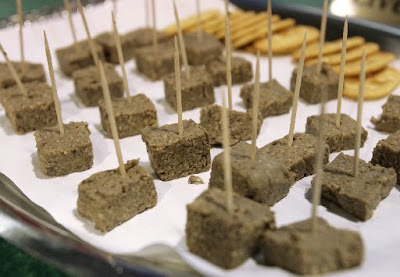
Liver pudding (aka livermush) samples, courtesy of Neese’s, at the N.C. State Fair.

This is it. When the Democratic National Convention arrives (and even beforehand) the world will be looking at Charlotte. What better time for this city to embrace its true, unique and authentic culinary heritage?

No, I’m not talking about vinegary barbecue (as today’s New York Times article reports). The Times fell for the spin. Vinegary barbecue is a North Carolina culinary heritage but is not at all unique to Charlotte or the greater Charlotte metro region. (Related note: a small squabble has broken out among barbecue fans over whether Charlotte has any great barbecue restaurants. Some say Bill Spoon’s on South Boulevard. Others favor Bubba’s off I-77 north, and some contend Mac’s has the best. Regardless, none has the fame and national following of places such as Lexington BBQ No. 1, Wilber’s in Goldsboro, the Skylight Inn in Ayden, Bridges (both of ’em) in Shelby, or even Stamey’s in Greensboro.

What does Charlotte have that the world does not? We have livermush. Don’t turn up your nose.

If you treasure authentic roots foods, livermush is ours. Why not celebrate that instead of acting ashamed? In Observer food writer Kathleen Purvis’ livermush magnum opus from 2000 (alas, I couldn’t find a link) she quotes John Egerton, the Nashville-based author of the authoritative guidebook “Southern Food.” “I don’t ever remember seeing a dish called livermush anyplace else [outside of North Carolina],’ he said. “And I hope never to see it again.” Bah!

Livermush even has a listing in Wikipedia. That page takes you to a 2004 Christian Science Monitor article on livermush. And here’s a nice roundup from October, by Andrea Weigl.

Weigl makes it sound as if livermush is an all-over-N.C. thing. It isn’t. Go to most regular-Joe breakfast places in Charlotte and this region – I mean places where menus offer biscuits and grits and sausage patties and other normal breakfast food – you will see livermush on the menu. Or maybe they’ll call it liver pudding. True, too many chain-type places owned by out-of-town corporations do not offer livermush. That’s their loss, and their lost business.

Go roughly 80 miles in any direction from Charlotte you aren’t likely to see livermush on the menu – not in Asheville, not in Columbia, not in Fayetteville, not in Raleigh. Maybe, if you’re lucky, you can buy it at a grocery store. I had my first livermush when I lived in Fayetteville, but only because Charlotte native David McKnight kept telling me to try it and told me how you just fry it up in a pan. I did. And it was quite tasty. Crunchy edges, with a soft interior, not too heavy on the liver, either. When I spent the 2007-08 year living in Cambridge, Mass., I asked Charlotte visitors to please bring livermush. Did you know it freezes nicely?

Until four or five years ago Charlotte had its own livermush manufacturer, Jamison’s. They stopped making it, though Ronnie Jamison told Purvis last summer they had contracted with “a company in the mountains” to make it. Another well-known brand is Guilford County-based Neese’s, which claims liver pudding and livermush are different. Mack’s is made in Shelby, about 40 miles west of Charlotte and possibly the livermush epicenter of the world. I was in a Shelby convenience store recently and noticed three different brands, two of them locally made. In a convenience store! Shelby of course has its Livermush Expo every year. The 2011 Livermush Expo will be Oct. 22 at Court Square in uptown Shelby.)
So please, if you’re a proud Charlottean bragging to out-of-town pols or pundits or journalists, remember what our real roots food is. And, like those green eggs and ham, if you have not tried it – you should.

Hey Dems, we do have indoor plumbing

Observer staff photo (May 18,2010) by David T. Foster III

I’m already hearing from out of town friends about their plans to come to Charlotte for the Democratic National Convention. A pal who runs the BBC’s North America bureau sent word that the BBC had already booked 50 rooms. Then he e-mailed back that “the city have told all hotels not to take bookings…..12 thousand rooms…..” Word is the DNC controls hotel room allotments. I wonder if that means we should clean the junk out of our guest rooms and pick up some income from less-well-funded members of the world’s news media.

I’ve been trying to think of what to tell our global visitors they should expect in the Queen City. You know many will arrive imagining the usual stereotypes of The South – unpainted shacks, no indoor plumbing, cousins marrying cousins, overseers and sharecroppers visible in every cotton field, mules hauling cotton to the cotton gin, hellfire and brimstone preachers thumping Bibles on every corner. You get the picture.

Do they realize:

• That Charlotte is a hotbed of Presbyterianism? (Don’t you love seeing “hotbed” and “Presbyterian” in the same sentence?) Sure, there are places where people rock ‘n’ roll and even dance, but you’ll rarely see a local elected or business official cutting the rug or belting a show tune after too many beers.

• That when our civic leadership encounters a problem, the first instinct is to form a large and interminably meeting committee to talk it over?

• That not only do our civic leaders not care about the Confederacy, or even mention it in public, they don’t even mention the past of 20 years ago. Visitors hear much about our banks, and probably get a banking genealogy worthy of the Old Testament. Commercial National and Southern States Trust (aka American Trust ) begat American Commercial, which begat North Carolina National Bank which began NCNB (No Cash for No Body, is the local joke) and NCNB begat NationsBank, and NationsBank begat Bank of America, with many side deals along the way.

But I bet they won’t hear that this Banktown stuff is rather new. For a now barely mentioned century or so, Charlotte was a textile town, with company-owned mill villages and impoverished and uneducated mill workers.

• That despite Michelle Obama’s gracious praise, and despite North Carolina’s sitting at the acme of all barbecue cultures in the nation (take THAT, Texas!), Charlotte does not boast truly excellent barbecue joints – the kind of old cinder-block building with stacks of hickory wood and smoke coming out the back where you can get the most flavorful, juiciest, crispy-edged barbecue. For that you have to drive to Lexington (if you like Lexington style) or Shelby (if you like Western style) or east of Raleigh (if you like Eastern style). Best ‘cue I’ve had in Charlotte recently was at the Sharon United Methodist Church Boy Scout troop’s annual January barbecue.

Here’s as good a description as I’ve seen of Charlotte, courtesy of a commenter on the Huffington Post article about Charlotte being chosen for the convention [I’ve added some punctuation corrections]:

“Good luck here in Charlotte (my hometown), Mr. President. It’s a pleasure to have you coming to the Queen City. Strange things happen in the Carolinas, though. Nothing or no one here is ever what they seem to be. See that farmer over there in the overalls? He’s a billionair­e. See the banker-looking guy with the tassles on his shoes? He’s bankrupt – again. See all of those folks out front there in the audience smiling? Half of them are from S.C.”

And this tidbit: My Google search to see what the BBC was saying about Charlotte found the website of the Bible Believers Chapel on Lancaster Highway in south Charlotte. No, I am not making that up.

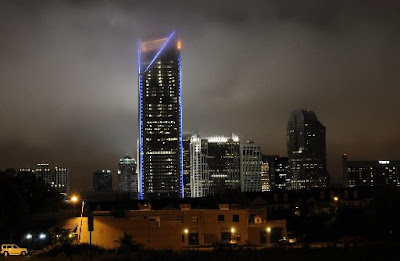
Finally, here’s a skyline photo roundup of dated skyline shots:

• The Washington Post online article shows the Time Warner Cable Arena (site of the actual convention), which opened in 2005, STILL UNDER CONSTRUCTION!

Politico.com’s piece shows an artsy, night-time shot with a construction crane that I’m pretty sure isn’t there any more.

• And while looking for Huffington Post coverage, I stumbled on this not-so-cheery story of the “13 surprising cities where foreclosures are soaring,” with Charlotte listed at No. 4. It, too, has the arena-under-construction photo. Geez.

When introverts hold office

I’m live-blogging from the Charlotte City Council’s retreat. I’m also Tweeting, follow @marynewsom.

I caught some possibly significant discussion for a time this afternoon, post-lunch and before the current budget presentation. Facilitator Mike Whitehead pointed out that most of the council members are “sort of introverted,” which means there’s a tendency for less communication. “You flaming extroverts know who you are,” he said, and laughter erupted from the table where Andy Dulin and James Mitchell are sitting. Those two are not what I’d peg as introverts.

Then Whitehead gave the formula he says is sometimes used in corporate America NC = MSU. That stands for “No communication? Then people make stuff up.” The lesson, he said, is to communicate better with each other, so people know what’s going on.

And, he said, you could communicate better with the media. (Colorful type font for emphasis is mine.) Answer questions and give data, he said, especially since a lot of the data is public record anyway.

But Mayor Anthony Foxx said he’d had experiences when C = MSU “and that’s a problem” He has sometimes talked to council members (“and you know who you are”) and then they tell reporters something else. Hmmm. So I think he just accused some council members of lying to the news media. If you’re a journalist, let me note, the only thing surprising about all that is for the mayor to call it out publicly.

When introverts hold office

I’m live-blogging from the Charlotte City Council’s retreat. I’m also Tweeting, follow @marynewsom.

I caught some possibly significant discussion for a time this afternoon, post-lunch and before the current budget presentation. Facilitator Mike Whitehead pointed out that most of the council members are “sort of introverted,” which means there’s a tendency for less communication. “You flaming extroverts know who you are,” he said, and laughter erupted from the table where Andy Dulin and James Mitchell are sitting. Those two are not what I’d peg as introverts.

Then Whitehead gave the formula he says is sometimes used in corporate America NC = MSU. That stands for “No communication? Then people make stuff up.” The lesson, he said, is to communicate better with each other, so people know what’s going on.

And, he said, you could communicate better with the media. (Colorful type font for emphasis is mine.) Answer questions and give data, he said, especially since a lot of the data is public record anyway.

But Mayor Anthony Foxx said he’d had experiences when C = MSU “and that’s a problem” He has sometimes talked to council members (“and you know who you are”) and then they tell reporters something else. Hmmm. So I think he just accused some council members of lying to the news media. If you’re a journalist, let me note, the only thing surprising about all that is for the mayor to call it out publicly.

TARP saved our rears, economist says

I’m live-blogging the Charlotte City Council’s retreat. Follow me, also, on Twitter @marynewsom. And see my previous post: “Charlotte’s economy shows a lagging city.”

At the Charlotte City Council retreat, council member James Mitchell asked the panel of economists’ opinion of the stimulus spending.

UNCC economics professor John Connaughton said, “But for TARP we would all be selling pencils on the street corner.” We were that close to collapse, he said.

He goes on to say that if the U.S. is to regain its economic standing, “It’s not going to be in stealing manufacturing jobs from China.” Instead, in his view, it’s going to be in selling high-level services to the rest of the world, which makes an educated workforce even more important.

Charlotte’s economy shows “a lagging city”

I’m live-blogging (and tweeting – and Tweeting, follow me @marynewsom) from the Charlotte City Council’s yearly retreat. We’re about to hear from three economist-types about the 2011-12 economic outlook.

Council members were 45 minutes late for this session, as they all went out to West Charlotte for the Project LIFT announcement.

12:09 p.m. – Wells vice president and economist Anika Khan predicts Charlotte won’t recover the jobs we lost until 2014-15. Says unemployment won’t get as low as 8 percent until 2012. She calls Charlotte “a lagging city.”

12:15 p.m. Anika Khan says the local apartment market “starting to take off.” “We have still a way to go with the Charlotte office market.” Said retail still has an 11.3 percent vacancy rate.
She concludes, “Charlotte is positioned for growth. But it’s going to be slow and very modest.”

12:17 p.m. John Connaughton, UNC Charlotte econ prof and director of the UNCC Economic Forecast, opens by saying, “I’m far less optimistic.” He points out that North Carolina lost 283,000 jobs since recession started. Last year, he said, NC added only 10,000 jobs. That leaves 273,000 to go. “You can do the math,” he says, about how long it’ll take to make up the jobs at that rate.

12:25 p.m. Connaughton predicts it will be 5-6 years before Charlotte gets back to the same level of employment the city had at the peak in December 2007. Many of the jobs lost are blue-collar jobs that aren’t coming back, he said.
Also, there’s a “new normal” and people aren’t buying as much. Since 71 percent of the U.S. economy is personal consumption, he said, that means slower growth.
And “consumers are just not happy campers” he said. “Consumer confidence has been hammered.” Consumers don’t see job numbers that make them comfortable.

12:35 p.m. – Connaughton now talking about risk of double dip recession if oil prices go up much higher. For every 50 cents that gas prices go up, he says, it takes $150 billion out of U.S consumer pockets. He used to think the double-dip recession wasn’t likely. Now he’s not so sure.
He noted the huge cash reserves that banks are holding. “There’s plenty of cash out there. It’s just not getting into the hands of small businesses,” he says. That’s one thing that’s a real killer,” he said.

Connaughton also pointed out the need for North Carolina to restructure its tax policies. Property tax revenue will rise, but slowly, he said. But the state depends too heavily on the sales tax, which (see “new normal,” above) is becoming a smaller and smaller share of economic growth.

12:50 p.m. – Matt Martin, senior vice president of the Federal Reserve in Richmond, is less pessimistic than Connaughton.
He says the construction jobs we saw at the peak aren’t coming back. It was 6 percent of U.S. GDP at the peak, he said, which was high for historic norms. Now it’s less than 3 percent.
And the lost manufacturing jobs won’t come back, either, he said.

Historic streetcar – an expose of sorts

Historic streetcar rail exposed on North Tryon Street. Photos by Mary Newsom

This posting is an excuse to share some photos that history enthusiasts and rail-lovers might enjoy. Pavement flaws in North Tryon Street uptown have exposed the reality that the city’s old streetcar tracks are still down there. Here’s a hat tip to Les Epperson of the city’s Special Services division, which cares for some key parts of uptown. When I was interviewing him about sidewalks and snow removal (see last Saturday’s op-ed, “City walkability goal hits an icy patch”), he mentioned that streetcar rails were visible where the pavement was worn, in the 500 block of North Tryon. I took a walk last week and sure enough, in front of the First United Methodist Church, I spotted them.
The rails aren’t in very good condition – not surprising for metal that’s been paved over multiple times. Epperson said not all the rails remain; some have been removed for various street projects.

For the record, Charlotte’s last streetcar was put out to pasture in 1938. Streetcar No. 85 was the centerpiece of a “Good-bye To Trolleys” celebration at The Square on March 14, 1938. That car ended up being found in a Huntersville pasture in the 1980s, restored and then it ran for about 10 years, operated by the nonprofit Charlotte Trolley, on what are now the light rail tracks down South Boulevard. It was put out to pasture again – this time to the CATS light rail barn – and awaits its next mission.
Charlotte, like many other U.S. cities, hopes to bring back streetcar service, but its plans don’t include North Tryon Street. Still, I like to imagine someone jackhammering up the asphalt on North Tryon and Car 85 running on those old rails again. In reality, of course, the condition of the rail (see close-ups below) and the missing rails make that impossible.

Historic streetcar – an expose of sorts

Historic streetcar rail exposed on North Tryon Street. Photos by Mary Newsom

This posting is an excuse to share some photos that history enthusiasts and rail-lovers might enjoy. Pavement flaws in North Tryon Street uptown have exposed the reality that the city’s old streetcar tracks are still down there. Here’s a hat tip to Les Epperson of the city’s Special Services division, which cares for some key parts of uptown. When I was interviewing him about sidewalks and snow removal (see last Saturday’s op-ed, “City walkability goal hits an icy patch”), he mentioned that streetcar rails were visible where the pavement was worn, in the 500 block of North Tryon. I took a walk last week and sure enough, in front of the First United Methodist Church, I spotted them.
The rails aren’t in very good condition – not surprising for metal that’s been paved over multiple times. Epperson said not all the rails remain; some have been removed for various street projects.

For the record, Charlotte’s last streetcar was put out to pasture in 1938. Streetcar No. 85 was the centerpiece of a “Good-bye To Trolleys” celebration at The Square on March 14, 1938. That car ended up being found in a Huntersville pasture in the 1980s, restored and then it ran for about 10 years, operated by the nonprofit Charlotte Trolley, on what are now the light rail tracks down South Boulevard. It was put out to pasture again – this time to the CATS light rail barn – and awaits its next mission.
Charlotte, like many other U.S. cities, hopes to bring back streetcar service, but its plans don’t include North Tryon Street. Still, I like to imagine someone jackhammering up the asphalt on North Tryon and Car 85 running on those old rails again. In reality, of course, the condition of the rail (see close-ups below) and the missing rails make that impossible.

Threats to historic buildings – from the government

The owner of the landmark P&N Railway Depot (above) wants to demolish it rather than meet city’s code demands.

You may have read the op-ed I did in November (“City may seek landmark demolition”), pointing to an unintended consequence of the city’s new non-residential building code – several demolition orders going out to designated historic landmarks that weren’t in good repair.

Or maybe you caught the WFAE report last week on the Davis General Merchandise store, a century old historic landmark which has been ordered to make repairs, and whose aging outbuildings were ordered demolished if repairs weren’t made.

Yes, this is yet another example of your city government and city elected officials being oblivious to the value of old buildings and historic buildings – and not just landmarks – when they adopt city policy. They’re not necessarily hostile, just oblivious to the issue. Witness the happy ease with which planners and council members adopted zoning standards for transit-station areas that allow buildings so tall they’ll alter the property value landscape, making smaller older buildings in places such as NoDa worth so little compared to the land they’re on that owners won’t even blink before razing them for towers.

As today’s Observer editorial (“Historic landmarks? City turns blind eye”) points out, City Council members say they didn’t even discuss, when talking about the proposed ordinance last spring, what its effect might be on historic buildings. That’s telling.

Walter Abernethy, the city’s code enforcement director, says the issue did come up during stakeholder meetings before the ordinance was proposed. But the ordinance has little in it to protect landmark buildings.

Ted Alexander, with Preservation North Carolina, points out that PNC has covenants on the Davis store to protect it – though whether that could prevent demolition is, for now, an open question. (I’ve asked Ted but haven’t heard back yet.) And it’s important to remember that the city hasn’t ordered demolition of the store and isn’t pushing for it. It just wants repairs, which owner Silas Davis would have to pay for. Davis, when I talked to him Friday, was irate about the whole situation and said he didn’t have the money for the repairs.

But as the editorial points out, it’s the historic old Thrift depot that faces the more immediate threat. Its owner, CSX railway, would prefer not to spend what it would require to bring the building up to code. It’s asking for a demolition permit. Because it’s a landmark, the county historic landmarks commission can delay the demo for up to a year, but can’t prevent demolition.

A few N.C. municipalities have gotten special legislation to let them absolutely forbid demolition in some selected cases. New Bern, for instance, can forbid demolition in its historic districts, although there are some procedural hoops everyone has to jump through.

Is the city’s oblivion toward historic landmarks due in part to the governmental organization that has the landmarks commission lodged as part of the county government? Possibly. But notice that the Historic District Commission (not the same as the landmarks commission but with some similarities), is part of the city’s planning department.