Transit, taxes and Tampa

This one is for transit and tax-policy wonks. It’s a piece from Yonah Freemark, in The Transport Politic, about the problems many transit systems are facing with sinking revenues. “When the recession strikes, little maneuvering room for transit” He points out that one reason for the problem is over-reliance on a very volatile revenue stream: sales taxes.

Most cities have been especially affected by the recession because of their reliance on the sales tax to provide revenue. Of the recent referendums on transit expansion programs, almost all have involved a 1/2 cent or one cent increase in that tax; few cities have looked to other forms of revenue, like an income tax or a payroll tax. The consequences of this decision, however, have been devastating because sales tax revenues have fallen considerably as a result of the recession and the reduced standard of living experienced by the majority of Americans over the past few years. A more stable financing program for transit, using other forms of taxation, would ensure that planned projects actually get built.

If you want to get deep in the weeds of transit finance, follow the link on “financing program for transit,” above. I haven’t read it all the way through yet, but it looks at the New York and Paris transit systems and how they get and spend their money.

In other transit-related news, here’s a piece about Charlotte that ran Sunday in Tampa, Fla., where voters next month will decide on – you guessed it, a sales tax – to pay for transit as well as roads and other transportation needs.

And here’s a fun contrarian piece from the Market Urbanism blog, “The Great American Streetcar Myth,” by Stephen Smith, who contends it wasn’t General Motors and Standard Oil who killed off streetcars as much as the Progressive Era and New Deal planners and politicians. Fare-increase restrictions, labor union requirements, publicly paid street-paving and road-building all combined to finish off streetcars, he writes. It’s an interesting perspective. Smith also points out:

“While the status quo’s more libertarian-minded backers will point to the gas tax as a user fee, the highway funds are hardly adequate to cover the true costs. Though state and federal governments do now cover most of the capital and operating costs of the highways, local roads are still paid for almost entirely out of general revenues. And when you consider the forgone taxes and opportunity costs, roads start to look severely underpriced – to say nothing of the last hundred years of subsidized road building (the mainstay of FDR’s WPA), eminent domain, anti-urban federal home tax breaks and lending programs, positive feedback loops, and density-limiting zoning and parking policies.”
Looking at congestion a different way

A new report on urban traffic skewers methods used by the widely quoted Texas Transportation Institute. In traffic circles, this is huge. The TTI’s Urban Mobility Report is frequently used by cities to justify huge expenditures for wider streets and intersections. But it is deeply flawed, says a new report, “Driven Apart,” from the nonprofit group CEOs for Cities. It doesn’t consider that in some cities you don’t have to drive as far as in other cities. The more compact cities, where you don’t have to spend as much time in traffic, actually can end up looking more congested, because of the TTI’s formulas.
Follow the links above to read the report.

Also, Streetsblog New York City has a good, readable analysis of it here. It opens this way:

Imagine two drivers leaving downtown to head home. Each of them sits in traffic for the first ten miles of the commute but at that point, their paths diverge. The first one has reached home. The second has another twenty miles to drive, though luckily for her, the roads are clear and congestion doesn’t slow her down. Who’s got a better commute?
Shockingly, the standard method for measuring traffic congestion implies that the second driver has it better. The Texas Transportation Institute’s
Urban Mobility Report (UMR) only studies how congestion slows down drivers from hypothetical maximum speeds, completely ignoring how long it takes to actually get where you’re going. The result is an incessant call for more highway lanes from newspapers across the country.

“Driven Apart” shows how the key tool contained in the Urban Mobility Report – the Travel Time Index – penalizes cities with shorter travel distances and conceals the additional burden caused by longer trips in sprawling metropolitan areas. It also looks at the reliability and usefulness of the methodology used in the UMR and finds it doesn’t accurately estimate travel speeds, exaggerates travel delays and overestimates the fuel consumption associated with urban travel.

The report essentially makes the point that longer commutes are the main cause of time in traffic, not congestion per se.

“In the best performing cities – those that have achieved the shortest peak hour travel distances – such as Chicago, Portland and Sacramento, the typical traveler spends 40 fewer hours per year in peak hour travel than the average American. In contrast, in the most sprawling metropolitan areas, such as Nashville, Indianapolis and Raleigh, the average resident spends as much as 240 hours per year in peak period travel because travel distances are so much greater. These data suggest that reducing average trip lengths is a key to reducing the burden of peak period travel. Over the past two decades, for example, Portland, Oregon, which has smart land use planning and has invested in alternative transportation, has seen its average trip lengths decline by 20 percent.”

If you want to see the chart showing all the metro areas studied, see page 7 of this link.

On page 10 of that link is a section showing why the report’s authors say the Texas Transportation Institute’s Travel Time Index (the TTI’s TTI?) is flawed. The index is the ratio of average peak hour travel times to average free flow travel times. Here’s what it says, using Charlotte and Chicago as examples:

“Chicago has a TTI of 1.43 (the second highest overall, behind only Los Angeles), while Charlotte has a TTI of 1.25 (just about equal to the average for all large metropolitan areas). This would appear to indicate that urban travel conditions are far worse in Chicago. But the traffic delays in the two regions are almost identical (40 and 41 hours per year, or about 10 minutes per day). Chicago has average travel distances (for peak hour trips) of 13.5 miles, while Charlotte has average travel distances of 19 miles. Because they travel nearly 50 percent farther then their counterparts in Chicago, Charlotte travelers end up spending a lot more time in traffic, about 48 minutes per day, rather than 33 minutes per day.”

But the TTI makes it look as if drivers in Chicago have it worse. But if you look at hours spent in traffic they have it much better. The gives a flawed view of reality, the report says.

In sum, says the report:
“The Urban Mobility Report’s key measure – the Travel Time Index – is a poor guide to policy, and its speed and fuel economy estimates are flawed. In the aggregate, the analysis appears to overstate the costs of traffic congestion three-fold and ignores the larger transportation costs associated with sprawl.”

It points out, for example, “There are strong reasons to doubt the UMR claim that slower speeds associated with congestion wastes billions of gallons of fuel. The UMR estimates of fuel consumption are based on a 29-year-old study of low-speed driving using 1970s era General Motors cars, which is of questionable applicability to today’s vehicles and to highway speeds.”

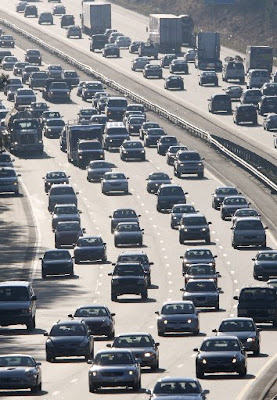
Photo caption: Raleigh-Cary traffic, from photographer Shawn Rocco, [Raleigh] News & Observer

Raleigh mayor takes on Wake schools flap

Today, I’ve got limited time so I’ll share a couple of interesting links.

1. Raleigh’s Mayor Charles Meeker is “quietly assembling a group of town mayors and ‘high level’ residents to scrutinize the student assignment plan currently being developed by the school board.” The News & Observer’s article is here. The situation is intriguing on a variety of levels.

A. Obviously, the fate of a city’s school system has a huge impact on the city’s overall economic and social well-being. Yet while our former mayor, Pat McCrory, was in office during years in which Charlotte’s public schools were in intense reassignment and re-segregation turmoil, he said virtually nothing publicly. It was a certainly a smart political survival strategy for him — CMS and race are both radioactive topics. But was it the best thing for the city?

B. Meeker’s wife, Dr. Anne McLaurin, is on the school board. Yowie. Talk about power couples.

C. With Wake County schools threatened (by a controversial majority on the school board there) with the same re-segregation that has hit Charlotte-Mecklenburg Schools, the Raleigh political establishment seems to be fighting back more strongly than Charlotte’s did a decade ago. There were some key differences — a court case that had to be complied with. But CMS went beyond what the court rulings required in dismantling racial integration in local schools. And of course, seeing what happened here could be fueling some of the Wake opposition to re-segregation.

D. CMS, meanwhile, is talking about closing up to 10 schools and reassigning students. Here’s Observer reporter Ann Doss Helms’ blog account of the details, which are sure to be controversial. This could have major implications for neighborhoods’ stability and futures. Are city officials and county officials at the table with CMS as it comes up with its plans? I don’t think so. They should be, and if they weren’t invited, they should be knocking down Superintendent Peter Gorman’s door.

2. In today’s New York Times is an interesting piece on a ballot measure before Florida voters that would require voter approval on changes in state-mandated growth plans. The measure is fueled in part by deep anger over over-building and over-zoning. Good idea? Bad idea?

Raleigh mayor takes on Wake schools flap

Today, I’ve got limited time so I’ll share a couple of interesting links.

1. Raleigh’s Mayor Charles Meeker is “quietly assembling a group of town mayors and ‘high level’ residents to scrutinize the student assignment plan currently being developed by the school board.” The News & Observer’s article is here. The situation is intriguing on a variety of levels.

A. Obviously, the fate of a city’s school system has a huge impact on the city’s overall economic and social well-being. Yet while our former mayor, Pat McCrory, was in office during years in which Charlotte’s public schools were in intense reassignment and re-segregation turmoil, he said virtually nothing publicly. It was a certainly a smart political survival strategy for him — CMS and race are both radioactive topics. But was it the best thing for the city?

B. Meeker’s wife, Dr. Anne McLaurin, is on the school board. Yowie. Talk about power couples.

C. With Wake County schools threatened (by a controversial majority on the school board there) with the same re-segregation that has hit Charlotte-Mecklenburg Schools, the Raleigh political establishment seems to be fighting back more strongly than Charlotte’s did a decade ago. There were some key differences — a court case that had to be complied with. But CMS went beyond what the court rulings required in dismantling racial integration in local schools. And of course, seeing what happened here could be fueling some of the Wake opposition to re-segregation.

D. CMS, meanwhile, is talking about closing up to 10 schools and reassigning students. Here’s Observer reporter Ann Doss Helms’ blog account of the details, which are sure to be controversial. This could have major implications for neighborhoods’ stability and futures. Are city officials and county officials at the table with CMS as it comes up with its plans? I don’t think so. They should be, and if they weren’t invited, they should be knocking down Superintendent Peter Gorman’s door.

2. In today’s New York Times is an interesting piece on a ballot measure before Florida voters that would require voter approval on changes in state-mandated growth plans. The measure is fueled in part by deep anger over over-building and over-zoning. Good idea? Bad idea?

“Pimp My CATS” and other ideas

From TEDx Charlotte (see earlier post, “Are we Innovative yet?”) :

The day kicked off with Tracy Russ and Quentin “Q” Talley. Russ was “Left Brain” and Q was “Right Brain.” The idea, of course, is that you need both. They pitched 10 ideas at once wacky and thoughtful (left-right brain convergence maybe?)
1. Give every tree in Charlotte-Mecklenburg a name. This will help stop the loss of our tree canopy. So, “maple tree” becomes “Mary Dilworth.” “When ‘Mary Dilworth’ croaks there are tears and people care,” Russ pointed out.
2. Bring “art recess” into the workplace.
3. “Your Zip Code or mine?” Make friends with someone from a different neighborhood and visit each other’s part of town.
4. “Bedsheets not spreadsheets.” This is NOT what you’re thinking. The idea is to collect, via a website, the hopes and wishes of people in the community. Then print them on blankets and give a blanket of hopes to every Charlotte newborn. (All together now: “Awwwww.”)
5. “Pimp my CATS.” The CATS here isn’t the Charlotte Area Transit System but “Creative Access to Song. The idea is to put live music onto city buses. (Or should they charge more for musical ads?)
6. “Have a Poet in Chief for the city.”
7. “Dais Divas” – As long as there’s drama on our elected bodies, let’s go for it. Get elected officials every year to get together and put on a musical. ( The “Glee” technique.)
8. Wisdom of the Elders. Return to the traditions of many cultures that respect and admire the elderly and use their wisdom. (I guess this means that a lot of people think anyone over 50 is irrelevant, since they’re telling people NOT to treat them that way. Downer of the day.)
9. All high school graduates go to college.

The rest of the morning has been a mixed set of beautiful art, oddly didactic lectures, bizarre math/physics guy, and ended with the incomparable Tim Will of Foothills Connect.

I’m missing lunch now. More to come.

TEDx Charlotte – Are we innovative yet?

10 a.m. – Waiting for TEDx to start, in basement auditorium at Knight Theater, looking at psychedelic floral video displays in darkened auditorium. Architect Tom Low of the Charlotte Duany PlaterZyberk Audience and founder of Civic by Design is pacing up front along with Manoj Kesavan, another local architect who’s one of the TEDx Charlotte organizers. We’re supposed to be learning about and experiencing innovative ideas, I think.

I should probably have read the material better. But this has been a week of 11- and 12-hour workdays. This morning before heading here I had to set out sprinklers for our newly re-seeded lawn, clean up last night’s dirty kitchen, make breakfast, fix a torn hem on my slacks, emails a friend who’s about to be unreachable, to set up the time and place for a lunch date, etc. etc. It reminds me of something I read recently, attributed to Jane Jacobs: An efficient city can’t be an innovative city. I conclude this applies to personal lives, too. Too many tasks, duties and to-do-list work eats away at the time your brain needs to float free.

So I wonder: Have the past decades of workplace pressure for increased “productivity” – which means fewer workers, more work, faster work, longer workweeks, constant availability to the office – has all that had an effect on U.S. innovation?

Want your face on the side of a bus? Now it’s possible

Advertising’s coming back to Charlotte city buses. And it’s coming to light rail cars – an option not available in 2001, when the governing body for the Charlotte Area Transit System voted to remove the ads from bus exteriors.

The Metropolitan Transit Commission’s vote was about as split as it is possible for such a vote to be. Each municipality has one vote, as do the county and the N.C. Board of Transportation representative (currently developer John Collett). The first vote Wednesday night, on a motion to approve the new advertising , was 4-4, with Matthews Public Works Director Ralph Messera abstaining. Because of the tie, MTC chair and Mecklenburg County commissioners’ chair Jennifer Roberts declared the motion failed, until someone pointed out an “abstain” vote is counted as a yes. That made the vote 5-4.

Messera said he abstained because, while he believed Matthews Mayor James Taylor was in favor, he had not had a specific conversation to nail down how he wanted Matthews to vote.

Olaf Kinard of CATS said projections showed CATS would clear between $900,000 to $1 million a year over five years, taking into account its expenses for putting the advertising program into effect

Revenue from the county’s half-cent sales tax for transit has been flat, while the system’s 2030 plan for building more light rail, streetcar and possibly bus rapid transit corridors is based on a projection that shows those revenues steadily climbing. So the MTC has been pondering whether to look for more revenue opportunities.

Why vote against what, to some, would seem a no-brainer idea for more revenue? Huntersville Mayor Jill Swain said she worried about quality control for the ads. Others pointed out that CATS has spent the past 10 years positioning itself, to the public, as a clean and efficient bus and transit system. The image issue was a key reason the MTC abandoned ads on buses in 2001. “We’re violating the brand we established 10 years ago,” said Davidson Mayor John Woods.

Looking ahead, there’s a decent possibility the MTC will go to voters in coming years for new taxes or other public revenue. It would be even harder for the MTC to ask for new public revenue if it were still rejecting a revenue stream that many in the public consider low-hanging fruit to be plucked.
Photo: Get ready for more advertising on CATS buses, such as this on promoting Charlotte Motor Speedway’s October races. Credit: Charlotte Observer file photo

Want your face on the side of a bus? Now it’s possible

Advertising’s coming back to Charlotte city buses. And it’s coming to light rail cars – an option not available in 2001, when the governing body for the Charlotte Area Transit System voted to remove the ads from bus exteriors.

The Metropolitan Transit Commission’s vote was about as split as it is possible for such a vote to be. Each municipality has one vote, as do the county and the N.C. Board of Transportation representative (currently developer John Collett). The first vote Wednesday night, on a motion to approve the new advertising , was 4-4, with Matthews Public Works Director Ralph Messera abstaining. Because of the tie, MTC chair and Mecklenburg County commissioners’ chair Jennifer Roberts declared the motion failed, until someone pointed out an “abstain” vote is counted as a yes. That made the vote 5-4.

Messera said he abstained because, while he believed Matthews Mayor James Taylor was in favor, he had not had a specific conversation to nail down how he wanted Matthews to vote.

Olaf Kinard of CATS said projections showed CATS would clear between $900,000 to $1 million a year over five years, taking into account its expenses for putting the advertising program into effect

Revenue from the county’s half-cent sales tax for transit has been flat, while the system’s 2030 plan for building more light rail, streetcar and possibly bus rapid transit corridors is based on a projection that shows those revenues steadily climbing. So the MTC has been pondering whether to look for more revenue opportunities.

Why vote against what, to some, would seem a no-brainer idea for more revenue? Huntersville Mayor Jill Swain said she worried about quality control for the ads. Others pointed out that CATS has spent the past 10 years positioning itself, to the public, as a clean and efficient bus and transit system. The image issue was a key reason the MTC abandoned ads on buses in 2001. “We’re violating the brand we established 10 years ago,” said Davidson Mayor John Woods.

Looking ahead, there’s a decent possibility the MTC will go to voters in coming years for new taxes or other public revenue. It would be even harder for the MTC to ask for new public revenue if it were still rejecting a revenue stream that many in the public consider low-hanging fruit to be plucked.
Photo: Get ready for more advertising on CATS buses, such as this on promoting Charlotte Motor Speedway’s October races. Credit: Charlotte Observer file photo

Demolition, part two

My posting last week, about a very nice two-story home demolished (“What’s the opposite of green? Maybe this”), has an update. Owner Max Redic says he’ll be building a new house on the site.

Redic said his family had lived in the house 10 years, had been thinking for five years about rebuilding. The house had mold and a 25-year-old HVAC system, he said. They’ve temporarily moved to another site in Charlotte and yes, he said, they do have a building permit for the new house. (The demolition permit posted said “Total res demo – No Build Back.”)

He said they recycled much of the building material, donated a good bit of the interior goods to Habitat for Humanity, and let the fire department use the house for training before the demolition.

And, he pointed out (as my blogpost had), it’s his property to do with as he wishes. A bit of context: The lot is near a number of others where nice, but older, houses have been torn down and much larger new ones built — some on spec by developers and some by homeowners.

Demolition, part two

My posting last week, about a very nice two-story home demolished (“What’s the opposite of green? Maybe this”), has an update. Owner Max Redic says he’ll be building a new house on the site.

Redic said his family had lived in the house 10 years, had been thinking for five years about rebuilding. The house had mold and a 25-year-old HVAC system, he said. They’ve temporarily moved to another site in Charlotte and yes, he said, they do have a building permit for the new house. (The demolition permit posted said “Total res demo – No Build Back.”)

He said they recycled much of the building material, donated a good bit of the interior goods to Habitat for Humanity, and let the fire department use the house for training before the demolition.

And, he pointed out (as my blogpost had), it’s his property to do with as he wishes. A bit of context: The lot is near a number of others where nice, but older, houses have been torn down and much larger new ones built — some on spec by developers and some by homeowners.