U.S. youth less car-crazy than their elders?

Something is changing in America. People aren’t driving as much – even taking into account that the recession and unemployment reduces commuting. Several people, including a writer for Ad Age magazine, have noticed a dip in the rates at which young people are getting driver’s licenses.

Jack Neff, writing in the May 31 AdAge.com, says, “The automobile, once a rite of passage for American youth, is becoming less relevant to a growing number of people under 30.” His piece shows the stats that back up that thesis.

Similarly, Nate Silver, writing in the May 6 Esquire, opens his piece this way: “This is surely one of the signs of the apocalypse: Americans aren’t driving as much as they used to.”

And the ubiquitous Richard Florida, writing at theatlantic.com, points to Neff and Silver’s articles and ponders whether his predicted “great reset” is taking place. This view dovetails nicely with Florida’s new book, “The Great Reset.” He’s been writing about “resets” for the Atlantic for some time now.

If you read the pieces it’s hard not to think they’re onto something. AdAge, especially, is known more for pointing to consumer trends than for worrying about issues such as the fiscal and environmental irresponsibility of suburban sprawl.

But here’s another sign that something truly is changing. Automakers *#8211; who have nothing if not a history of extraordinarily effecting ad campaigns – are changing the backdrops on their ads, using more sexy urban scenes and fewer beautiful wilderness scenes. Catherine Lutz and Anne Lutz Fernandez point this out in a June 3 Huffington Post piece, From Upstream to Downtown: Car Ads Head to the City. The two are authors of the book “Carjacked: The Culture of the Automobile and its Effect on Our Lives.” In the HuffPost piece, they write, “Just when some of us have decided we want to live in places where we don’t have to be quite so dependent on the automobile, the automobile is trying to follow us there.”

If you’re interested in more about “Carjacked” – a book I recommend as one that looks at the world in ways you probably hadn’t thought of before – here’s a Q/A I did with Fernandez for OnEarth.org.

More delays for Charlotte’s tree ordinance

Charlotte has lost half its tree canopy since 1985, and Mecklenburg County has lost a third of its. (Read the report on that – see page 70 of this pdf.) So plenty of eyes are on a proposal – moving through the bureaucracy with the speed of Providence Road traffic at 5:30 p.m. – to strengthen the city’s aging tree ordinance as it applies to commercial and multifamily development.

Finally, the plan was, the City Council’s environment committee would render its recommendation today at an 11 a.m. meeting. This isn’t final adoption, mind you, just a recommendation to be sent to the full council. The environment committee, which until Anthony Foxx was elected mayor last November was dominated by Republicans (on a council with a Democratic majority, mind you), has been gnawing on the ordinance since June 2008.

I don’t know what all local developers think of it, because that’s a large and diverse group – a fact you wouldn’t know if you listen only to the local developers’ lobbying group, REBIC. But REBIC and its members have been raising issue after issue for five years, first on the stakeholder committee, which could not reach consensus, and now as the ordinance is before the committee. During the stakeholder discussions REBIC used the time-honored “stall-it-by-demanding-a-cost-benefit-analysis” gambit, which took more than a year, in part because a few non-developers on the stakeholder committee suggested that maybe the anti-tree-ordinance folks shouldn’t be the ones who got to choose the sites on which the cost-benefits were being analyzed.
REBIC didn’t like the idea of pushing the required “tree save” from the current 10 percent up to 15 percent. They didn’t like the idea that trees in parking lots should be planted closer together. Those issues have been, I think, resolved.

Today two sticking points remained: The city staff’s proposal for how to deal with development on already-developed sites, and how to set the fees for a “fee-in-lieu” proposal, under which developers could opt to pay a fee rather than save the trees on a full 15 percent of the site. (It’s all very complicated.) REBIC’s preferred “fee-in-lieu” was laughable: just decide that all land in the city, for tree ordinance fee-in-lieu purposes, is worth $40,000 to $50,000 an acre and set the fees as if that were the case.

Council members offered several proposals to “compromise” between staff’s recommendations and REBIC’s ideas. Why the council members so rarely seem to just opt for their paid staff experts’ recommendations, which have already been compromised during stakeholder talks, is beyond me. But instead of voting today, the committee has punted until June 21.

Best quotes of the day: Both courtesy of District 6 rep Andy Dulin.
– In the context of his worries that the tree ordinance will add costs to development: “We’re going to jack up the cost of building a strip shopping center.”
“Developers love trees.”

For traffic geeks, policy wonks and more

Sharing tidbits and links:

– Lew Powell shared this article about a math whiz in Manhattan who is devising an intricate Excel program to show the cost to everyone from each car, truck, taxi or bus that enters Manhattan daily. It’s in Wired magazine. For congestion-policy geeks and others.

[Lew, for you who don’t know him, is now retired from his long-time role as Observer Forum editor, Buzz editor and office “wag” – as when people would write, “an office wag quipped … ” and recount a pithy and witty observation.]

– A sad, ironic note. The Mecklenburg County Park and Recreation Department recently learned it’s one of three finalists for the 2010 NRPA Gold Medal Award. It’s an annual award from the National Recreation and Park Association (NRPA) honoring excellence in management and planning of parks and recreation agencies. Of course, the county park department’s budget is being cut almost in half. It’s losing dozens of staff to layoffs, and some of its programs will have to be eliminated.

– Want to see a new promotional video for the city, done by the Charlotte Regional Visitors Authority (CRVA)? It’s at the bottom of this page. Cameos by Michael Jordon,
Winston Kelly, Anthony Foxx, a tray full of homemade biscuits and more. I note one shot early on is from – gasp! – the Daniel Stowe Botanical Gardens in Belmont (not Gastonia, as I wrote in haste Thurday night). That’s legit if you think of “Charlotte” as the region. Not sure about that Childress Vineyard clip, though. It’s up the road rather a ways, outside Lexington. Pick you up some Lexington BBQ on your way …

– Here’s a link to the piece in the Atlantic magazine about Andres Duany – a piece I referenced in my May 21 op-ed, “Jane Jacobs, Robert Moses and NIMBYs.” If you missed them, here are a couple of earlier posts on related topics, here and here. Both were written at a conference where Duany spoke, sponsored by the Lincoln Institute of Land Policy, the Nieman Foundation and the Harvard Graduate School of Design. Anthony Flint of Lincoln Institute sure wished I’d have mentioned that sponsorship in the print oped. I should have, he’s right.

‘Bright flight’ changes the face of cities, suburbs/Younger, educated whites moving to urban areas for homes, jobs – It’s a link to an Associated Press story on the msnbc.com web site. It refers to a Brookings Institution study released in May, but the link to the study on Brookings site is temporarily broken. This link takes you to the main Metropolitan Policy Program site at Brookings.

‘Tryon Bridge Towers’ artist did WWII Memorial

What ARE those things on South Tryon Street? The two metallic structures erected just past the Big O building at the bridge over I-277, are not, as you might have thought, witches-hat-derived homage to the show “Wicked.” They are a gift from the Queens Table, a group of anonymous – and apparently wealthy and influential – public art donors who have brought us the Socialist-realist monuments at The Square.

Update 3:30 PM – The artist is Friedrich St.Florian, an architect based in Providence, R.I. He designed the World War II Memorial in Washington. Here’s a link to a series of photos of the works being installed. The current name appears to be “Tryon Bridge Towers.”

Here’s a link (courtesy of the folks at CLTblog) to a presentation to the City Council in April 2009. It explains the Queens Table: “A small group of anonymous donors established the Queen’s Table Fund in 1991 to celebrate Charlotte by quietly finding and filling needs that are not otherwise being met to enhance aesthetics and quality of life in the City.” (May I suggest that art teachers for CMS could be an unfilled need for the next decade?)

Among their prior gifts, in addition to the four statues at The Square, are the Queen Charlotte at the airport (often described as “going into the lane for the layup”) and “Aspire,” the bronze on Kings Drive outside the Temple of Karnak-sized new Central Piedmont Community College building. I have come to love the airport statue, I confess. “Aspire” will have to grow on me. The things at The Square are an embarrassment, art as envisioned by aging CFOs, perhaps. (No I don’t know who really selected them.)

I am checking in with Jean Greer, Vice President of Public Art at the Arts & Science Council to see what she knows. (Update: Jean tells me the project didn’t go through the ASC Public Art Commission although she knew about it through Charlotte Center City Partners. It sits on N.C. DOT property, she says. The N.C. DOT is in the process of crafting an art policy for state rights-of-way.)

Jean is one of the lucky souls who gets to stand up at occasional City Council dinner meetings and give presentations on current public art projects and endure silly jokes from council member Andy Dulin and – for the 14 years he was mayor – Pat McCrory. McCrory buttonholed me last week at the James Jack statue unveiling to say he requires two things of public art for him to like it: You don’t have to be high to “get it” and it shouldn’t be something a 5th-grader could do. He approved of Chas Fagan’s James Jack statue.

I don’t know about this new work. At first, as I went past for several weeks I kept thinking it was some odd NCDOT construction equipment abandoned to the weeds. Then it became clear it was “art.”

Pardon me for sounding like McCrory but this one reminds me of robotic equipment, as portrayed on “The Jetsons,” or possibly a depiction of the trash compactors on Darth Vader’s Death Star. It does not make my heart soar. If anything, it destroys any soaring my heart might have been inclined to do. (Not that a soaring heart is likely as you walk across the bleak, Sahara-like I-277 bridge.)

Annual cost to the city, for maintenance, such as mowing, planting, electricity: $ 8,450.

New diet coming to Selwyn Avenue

Here’s a tidbit from the city council’s Friday memo. A section of Selwyn Avenue is on the schedule to join some other in-town streets in a “road diet.” As with East Boulevard and with several blocks of South Tryon Street, the city Transportation Department is going to shrink a chunk of Selwyn from four lanes to three.

The idea is that where you don’t need the lane capacity, having fewer lanes can A) encourage bicyclists by adding bike lanes or extra pavement width, and pedestrians and B) work to subtly slow traffic. After all, the biggest contributor to traffic accidents in a city is – not trees, not telephone poles, not bicyclists – speed.

Here’s the section from the memo. Warning, CDOT jargon ahead:

Selwyn Avenue Street Conversion
Staff Resource: Johanna Quinn, CDOT, 704-336-5606, jquinn@ci.charlotte.nc.us

Each year CDOT staff identifies streets scheduled for resurfacing that could be candidates for
conversions. Typically, these are streets where the curb to curb space can be reallocated from four travel lanes, to 3 travel lanes and bicycle lanes. CDOT staff evaluates operating conditions at intersections and street segments, analyzes connectivity and multi-modal travel factors, prepares a technical recommendation, and informs the public. CDOT moves forward with road conversions that provide benefits to bicyclists, pedestrians, and neighborhood residents, while continuing satisfactory traffic operations.

Selwyn Avenue is on the 2010 resurfacing list. Staff has determined that the four-lane segment between Queens Road West and Colony Road should be converted from four lanes to three lanes with a 3.5 ft. wide outside shoulder. The new three-lane configuration will have one through lane in each direction and a two-way center left turn lane with dedicated left-turn lanes at side streets. The installation of a dedicated left-turn lane at Colony Road will require removal of the peak two-hour turn restriction from southbound Selwyn onto Colony Road.

Area residents are aware of this conversion and have had the opportunity to provide feedback at a public meeting, online surveys, and through the Myers Park Homeowners Association. A postcard mailer was distributed May 14, 2010 to notify residents that the changes will be
implemented this summer.

Staff considered a street conversion for the last remaining four-lane segment of Selwyn Avenue between Queens Road West and Westfield Road, but decided against it. A conversion would have to be asymmetrical and would take away some lane width, which would affect cyclists who regularly use this road segment as part of the “booty loop”. Staff took this proposal to the Bicycle Advocacy Committee which decided that cyclists and motorists have settled into a travel pattern that functions well for all users in this area.

Resurfacing Selwyn Avenue is scheduled for June. This will allow resurfacing to take place during Queens University’s summer break and enough time for all resurfacing debris to be cleared before 24 Hours of Booty at the end of July.

iCatch the Light Rail

I sat next to CATS‘ honcho Olaf Kinard at the Monday city council dinner meeting and he showed me a new mobile phone app that CATS has worked up, with a local company Myjive Inc. It’s called iCatch LYNX. It shows you the closest Lynx (light rail) station, and when the next train is arriving.

It’s free. Just do an app search for iCatch LYNX and you’ll find it. Works on iPhone and Blackberries, he says. Phase II will work on Androids.

Kinard, who’s the director of marketing and communications, says they’ll have an app for buses, starting in about a month. Good. The Lynx schedule is easy to remember, and except in the early mornings on weekends, the trains are never more than 20 minutes apart. Buses are way more complicated, and sometimes if you miss one you’ll be waiting 50 minutes or more for the next one. Or all weekend, since some routes simply don’t operate on weekends.

Cap’n James Jack meets Tweet-world

Today’s big civic event, the unveiling of the statue of Colonial-era Capt. James Jack, as covered with Twitter. (For a stunning photo by the Observer’s Todd Sumlin, go to this slideshow and look for No. 19.)

Note to those unfamiliar with Twitter. People go by nicknames. On Twitter, I’m marynewsom, and my Tweets all begin with marynewsom. If you want to reply to someone else’s Tweet, you address it to them by using their Twitter name with @ in front.

Users can sort for a specific topic using codes that start with # and an agreed-upon moniker. Today’s was #mecdec.

WCooksey [City Council member Warren Cooksey, a Twitter champ among local pols] Less than 3 hours ’til the unveiling of “The Spirit of Mecklenburg” to honor May 20th & #MecDec. 1130 4th & Kings. Hope to see you there.

Greenmarketguy [Ted Boyd of Charlotte] Lots of folks here to see Capt Jack statue unveil.

CBJspanberg [Erik Spanberg of the Charlotte Business Journal] Meck Dec about to begin. Pols past, present everywhere: [Ex-Mayor Pat] McCrory, PHelms [ex-county commissioner Parks Helms], etc. James Jack statue unveiling to come. Plus funny hats.

marynewsom Ex-judge and history buff Chase Saunders (key to statue’s existence) raves bout Cokie Robt’s speech on role of women.

WCooksey Great crowd here at 4th & Kings for Capt. Jack statue unveiling. If you follow me, I’ve given you a sneak peek. [Wednesday night, from an event for donors, he posted this photo: http://twitpic.com/1pex16 ]

marynewsom Multiple bigwigs — & big hats on Colonial ladies — #meckdec day unveiling of James Jack statue. Speeches starting.

Greenmarketguy Mayor Foxx just arrived for #mecdec. Lot of elected officials.

CBJspanberg Other notables here: CCCP’s Michael Smith; council WCooksey, PKinsey [council member Patsy Kinsey], Bobbie Shields from county, CPCC’s Tony Zeiss and more.

CBJspanberg Mayor Foxx, county commish chair Jennifer Roberts on stage with ABC/NPR political analyst Cokie Roberts.

marynewsom Ooh. James Jack descendant sitting right in front o me. Great hat/great ponytail. I think he looks Texan. [I learn later he’s Brandon Jack, from McIntosh, Fla. Read on, there’s a photo of him.]

CBJspanberg Official event program promises Budd Berro’s message from “Governor Beth Perdue.” Yes, really.

CBJspanberg Mayor Foxx calls it one of the “red letter days” for Charlotte. “This statue will represent the very best of our community.”

marynewsom Olympic Hi student wins essay contest. Huzzah CMS. Taylor Claflin. She’s related to Victoria Woodhull,1st woman to run for prez.

CBJspanberg Olympic High student reading essay on Victoria Woodhull, famed political pioneer in 19th Century. Student is teaching pols.

marynewsom Great feminist speech, Taylor Claflin! Let stodgies in audience squirm.

marynewsom Sunburning as we listen to Jen Robts [county commissioners’ chair Jennifer Roberts]. Colonial folk in large hats now looking extremely wise.

WCooksey Cokie Roberts rightly notes greatness of USA is foundation on ideas, not ethnicity, geography, or other trad. bases of nationhood.

CBJspanberg Cokie Roberts: “This country is blessed because we are not haunted by our history.” Glue of America is its ideas.

Greenmarketguy The Kabuki drop for the statue about to happen!

CBJspanberg Sculptor Chas Fagan says Capt. Jack is “leaving his mark” at 4th and Kings. And now statue is revealed to applause.

WCooksey Here ‘tis! Huzzah! http://twitpic.com/1pfd33

marynewsom Statue now on view. Crowd awash in cameras. Now guy in tricorn us reading the #mecdec

itybtyctykty @WCooksey Hey, that’s pretty nice looking! Giving this statue a silly nickname may pose a challenge.

marynewsom Cap’n Jack rides off to Philly. Via 4th St.

marynewsom Crowd leaps in shock as muskets, cannons fire. I hope Capn Jack’s horse is far away.

minifail The descendants of Captain Jack get a ribbon #mecdec http://yfrog.com/0m8w8mj [This shows Brandon Jack of McIntosh, who sported an awesome ponytail, great hat and boots.]

WCooksey Here’s a closer view of “The Spirit of Mecklenburg.” Hope it’s in focus. http://twitpic.com/1pfg12

CBJgreennews [Susan Stabley of the Charlotte Business Journal] “Today, Charlotte is getting something that it sorely needs more of — a statue of a guy on a horse.” http://bit.ly/awGWOy
[Quote and link are courtesy a blog by Jeremy Markovich of WCNC-TV. Excerpt: “For those of you who need exciting imagery, think Cavalia with fewer tricks and more tri-corner hats.”]

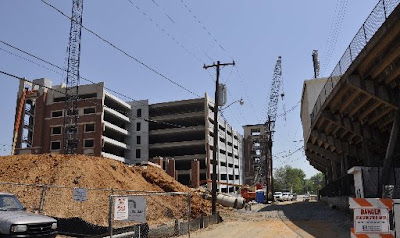
Parking decks coming to your neighborhood?

Central Piedmont Community College deck at Seventh and Charlottetowne has angered the Elizabeth neighborhood

Although the 9-1 vote (Warren Cooksey voted no) creating the Wilmore Historic District was the biggest headline out of the City Council’s Monday night meeting, the most interesting discussion took place around a somewhat obscure proposal from the city planning staff.
Several council members appeared to think the provision would allow parking decks in residential areas where they are now barred. (For the record, this is not what it would do, as you’ll see if you read on.)
But you can’t blame people for some confusion. The measure was on the agenda as a public hearing on Petition No. 2010-033, described this way in the lovable language of the planners: “… a text amendment to add new regulations making parking decks constructed as an accessory use to an institutional use exempt from the floor area ratio (FAR) standards, when located in the single family and multi-family zoning districts, provided certain requirements are met …”

The exemption from FAR standards (don’t even ask, I have been writing about planning for 15 years and I’m still not totally clear how FAR works) is intended to offer an incentive to institutions such as churches, colleges and hospitals to build parking decks instead of surface parking lots – in areas where the decks are already allowed but because of the FAR standards they’re more expensive to build. And with the appearance requirements, such as plantings, the decks would look a wee bit better, too.

“I have a problem with parking decks in residential districts,” at-large council member Susan Burgess said.

Planner Tom Drake, who was at the microphone: “This is not a precedent here.”

Burgess (incredulous tone): “In R-3 and R-4, surface parking and parking decks are permitted?”

Drake: “Yes.”

Burgess: “How did that happen?”

Drake: “They’re accessory uses.”

Burgess: “Has that always been the case?”

Drake: Yes, in my 20 years here (I paraphrased his lengthier reply. Meanwhile, Planning Director Debra Campbell and planner Sandy Montgomery, sitting in the audience, nod vigorously.)

Of course, if you’ve gone past Carolinas Medical Center or numerous large churches or Queens University (fixed from “College”) in the past 10 years you’ll see plenty of large parking lots and decks built in residential areas. Heck, CMC owns huge chunks of the Dilworth neighborhood and it isn’t likely they’re going to get deeply into the real estate business, but rather they’re going to build more medical facilities with vast parking facilities.

Parking is a huge dilemma for Charlotte and most other cities. No one likes a parking lot next door, but get us into our cars and we LOVE parking places. (See my recent column on the topic.) What this provision would do, if it works as intended, would encourage those institutions to build vertically instead of spreading asphalt across three or four times the land area a deck would cover. Sounds like a good idea. Assuming everyone can figure out what it means …

Charlotte, a Smart Growth mecca?

Charlotte, a Smart Growth mecca? Some of you are laughing, having witnessed or maybe even lived through our miles and miles of definitively suburban sprawl.

Others of you are probably listening for the black helicopters that will swoop in and snatch our freedom as the socialists central planners triumph.

I guess we’ll have a chance to see which vision triumphs, next Feb. 3-5, when the EPA’s 10th Annual New Partners for Smart Growth Conference arrives in Charlotte. To see more, visit the conference website.

Here’s your chance for some input. Lee Sobel of the EPA’s Office of Policy, Economics and Innovation, sent a notice of the conference’s call for session proposals – a way you can submit ideas for breakouts, workshops, trainings, tours, or networking activities. This being, after all, the federal government you may submit your ideas via the “CFSP Submittal Form.” It, and the “CFSP Instructions” are posted on the session proposals section of the conference website. Deadline to offer your ideas: June 30.

All are invited to offer ideas. Some of the sessions at the 2010 conference in Seattle dealt with passenger rail, safe [pedestrian] routes to schools, health and the built environment, Smart Growth and race relations, etc. My suggestions – and no I’m not submitting a CFSP Submittal Form”: Surviving and Thriving in the Down Economy; exploring the financial burden sprawl puts on local and state governments; Dealing with Legislators.

I note they’ll award a Lifetime Achievement Award to someone. Past winners have been former King County (Washington) Executive Ron Sims, now deputy secretary at HUD; ex-Maryland Gov. Parris Glendening; Dr. Richard Jackson, formerly director of the CDC’s National Center for Environmental Health and now a professor at University of Michigan; and Walkable Communities founder and pedestrian/bicycle advocate and occasional Charlotte visitor Dan Burden (who would absolutely wins the “epic mustache award” if they had one. Great guy.)

The Saturday lawn edition of Naked City

Two lawn-related items of interest popped into my inbox this week – just in time for your weekend. If you have a suburban lot as I do, you know that lawns take time. The darn things grow and need mowing. The darn weeds grow much faster than the lawn. Because I don’t like too many chemicals we are plagued with ground ivy and clover and crabgrass and things I don’t know the name of. I have spent 20 years battling wild onions (the best solution I have found is to dig up the whole clump, dirt and all, even though it leaves the ground looking as if you’d been hit with some sort of miniature bombardment blitz). I’m afraid to jinx it but I think the dig it all out technique seems to have worked.

And I really do enjoy gardening and yard work. Up to a point. Mowing the lawn is beyond that point, and it takes time away from the things I really like: planting and harvesting flowers and veggies. My husband hates it. Our teenaged daughter hates it unless she is being paid really really well and it’s under 85 degrees.

So I felt kinship with Ventura, Calif., City Manager Rick Cole, who decided “No Lawn!” Ventura is on the coast, northwest of Los Angeles, and it sounds as if grass isn’t any easier to grow there than in Charlotte, where our summers are too hot for cold-weather grasses and our winters are too cold for hot-weather grasses. Cole writes a city manager’s blog. Take a look. (As a wonk I confess to being as interested in the entries on California taxes as on lawns. Apparently the California state government is raiding municipalities’ property tax revenues. Shhh. Don’t tell the folks in Raleigh!)

And I laughed at this offering from Phil Clutts of Harrisburg, occasional correspondent as well as limerick writer. He can’t trace the original authorship online. The first reference I saw on a Nexis.com search came in 1999 and it was being shared even then. It’s possible I was the last American not to have read this.
The Lord and St. Francis

“Winterize your lawn” the big sign outside the garden store commanded. I’ve fed it, watered it, mowed it, raked it and watched a lot of it die anyway. Now I’m supposed to winterize it? I hope it’s too late. Grass lawns have to be the stupidest things we’ve come up with outside of thong swimsuits! We constantly battle dandelions, Queen Anne’s lace, thistle, violets, chicory and clover that thrive naturally, so we can grow grass that must be nursed through an annual four step chemical dependency.

Imagine the conversation The Creator might have with St. Francis about this:

“Frank, you know all about gardens and nature. What in the world is going on down there in the Midwest? What happened to the dandelions, violets, thistle and stuff I started aeons ago? I had a perfect, no-maintenance garden plan. Those plants grow in any type of soil, withstand drought and multiply with abandon. The nectar from the long-lasting blossoms attracted butterflies, honey bees and flocks of songbirds. I expected to see a vast garden of colors by now. But all I see are these green rectangles”.

“It’s the tribes that settled there, Lord, The Suburbanites. They started calling your flowers ‘weeds’ and went to great extent to kill them and replace them with grass.”

“Grass? But it’s so boring. It’s not colorful. It doesn’t attract butterflies, birds and bees, only grubs and sod worms. It’s temperamental with temperatures. Do these Suburbanites really want all that grass growing there?”

“Apparently so, Lord. They go to great pains to grow it and keep it green. They begin each spring by fertilizing grass and poisoning any other plant that crops up in the lawn.”

“The spring rains and cool weather probably make grass grow really fast. That must make the Suburbanites happy.”

“Apparently not, Lord. As soon as it grows a little, they cut it – sometimes twice a week.”

“They cut it? Do they then bale it like hay?”

“Not exactly, Lord. Most of them rake it up and put it in bags.”

“They bag it? Why? Is it a cash crop? Do they sell it?”

“No, sir. Just the opposite. They pay to throw it away.”

“Now let me get this straight. They fertilize grass so it will grow. And when it does grow, they cut it off and pay to throw it away?”

“Yes, sir”.

“These Suburbanites must be relieved in the summer when we cut back on the rain and turn up the heat. That surely slows the growth and saves them a lot of work.”

“You aren’t going to believe this, Lord. When the grass stops growing so fast, they drag out hoses and pay more money to water it so they can continue to mow it and pay to get rid of it.”

“What nonsense! At least they kept some of the trees. That was a sheer stroke of genius, if I do say so myself. The trees grow leaves in the spring to provide beauty and shade in the summer. In the autumn they fall to the ground and form a natural blanket to keep moisture in the soil and protect the trees and bushes. Plus, as they rot, the leaves form compost to enhance the soil. It’s a natural circle of life.”

“You better sit down, Lord. The Suburbanites have drawn a new circle. As soon as the leaves fall, they rake them into great piles and have them hauled away.”

“No! What do they do to protect the shrub and tree roots in the winter and keep the soil moist and loose?”

“After throwing away your leaves, they go out and buy something they call mulch. They haul it home and spread it around in place of the leaves.”

“And where do they get this mulch?”

“They cut down trees and grind them up.”

“Enough! I don’t want to think about this anymore. Saint Catherine, you’re in charge of the arts. What movie have you scheduled for us tonight?”

“ ‘Dumb and dumber,’ Lord. It’s a real stupid movie about…”

“Never mind. I think I just heard the whole story.”